
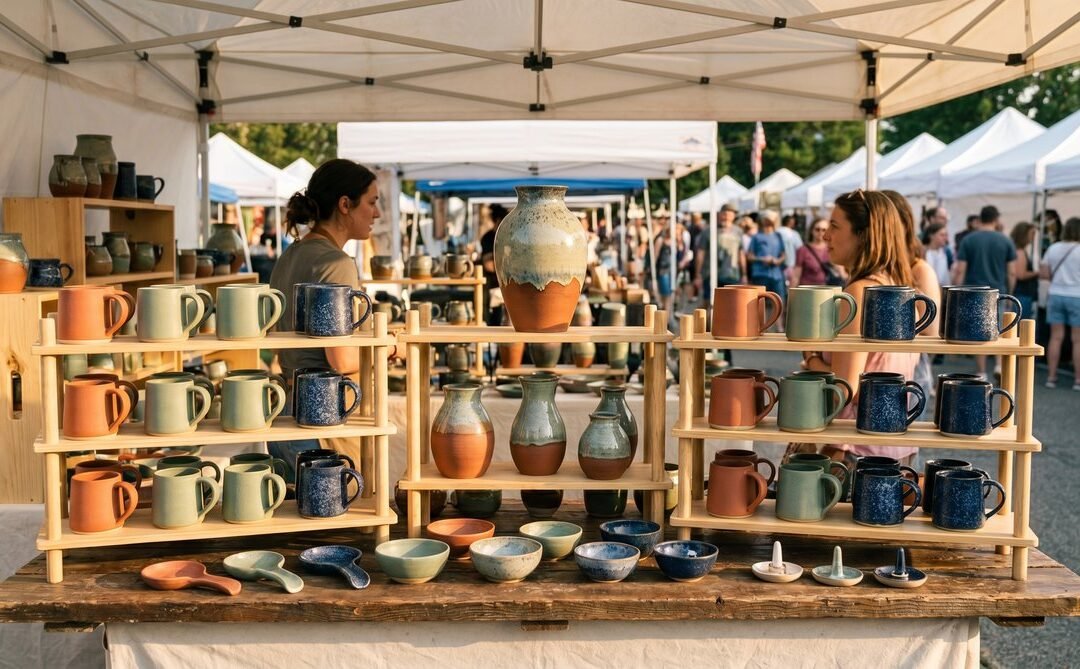
What pottery sells best at markets? Mugs are the consistent number-one seller at almost every craft fair and farmers market, priced between $25 and $65. Small functional pieces under $20 (ring holders, spoon rests, soap dishes) drive impulse buys, while vases lead gift purchases. Bowls sell steadily year-round. Functional pottery across a wide price range outperforms purely decorative work.
Mugs: the reliably best-selling pottery item at any market
If you only make one thing for your summer booth, make mugs. Meesh Pottery’s 2024 year-end sales breakdown names mugs as the top seller by a wide margin, and most working potters tell the same story. They are the rare item that hits every buyer category: the casual browser who wanted a souvenir, the regular who collects from the same artist every year, the gift-shopper picking up something for a coworker.
Pricing matters more than people think. The sweet spot sits between $25 and $65. Below $25, buyers start to question whether it is really handmade. Above $65, most farmers market shoppers tap out. We suggest stocking a range: $28-$38 for your bread-and-butter mugs, $45-$55 for taller or specialty forms, and one or two showpiece mugs at $60-$80 to demonstrate ceiling.
Why mugs win is partly cultural. Coffee and tea are daily rituals, and people upgrade rituals when they can afford to. A $4 mug from a discount store does the job. A $35 handmade mug from a potter you met at a Saturday market is something else entirely. The buyer is paying for a small daily moment of beauty, not a vessel. That is the entire pitch, and it works in any weather.
Variety keeps people at your table. Different handles (pulled, slab, ear-shaped), different glaze families (matte earth tones, glossy speckled, satin pastels), and different sizes (espresso cup, standard 12oz, oversized 16oz latte mug) give browsers reasons to linger. The longer they stay, the more likely they buy. If you want a deeper look at what makes a handmade mug actually worth paying more for, the form, the handle pull, and the weight in the hand all do most of the work.
Small functional pieces: your gateway items
The single best move you can make to grow market revenue is to stock what working potters call gateway items: small, useful pieces priced between $12 and $25 that turn a browser into a buyer.
The list is short and proven:
- Ring holders (especially novelty animal forms)
- Spoon rests
- Soap dishes
- Sponge holders
- Garlic graters
- Salt cellars with little wooden spoons
- Incense holders
Meesh Pottery’s report includes a striking data point: she sold 20 tiny elephant ring holders at a single festival, priced between $12 and $18, and ran out before the day ended. That is not a fluke. Small novelty functional items hit the exact psychological spot where a buyer thinks, “I can support a local artist and bring something handmade home without it being a financial decision.”
Gateway items also do a second job. Once someone has handed you cash, they have crossed from browser to customer. They are far more likely to buy a second, larger piece in the same transaction. We have seen sellers report that roughly a third of buyers who pick up a $15 ring holder also walk off with a mug.
The competition argument matters here too. A $15 handmade ring holder competes directly with a $9 mass-produced one on Amazon, and the handmade one wins almost every time at that price point. Above $25, the comparison shifts and Amazon stops being relevant. Below $25, you are still in impulse territory but offering something Amazon cannot.
Vases and bowls: the gift purchases and statement pieces
Vases are the dark horse of the pottery booth. They do not move in the volume that mugs do, but per-piece revenue is higher and they pull a different customer entirely: the gift shopper.
Three tiers work:
- Bud vases ($20-$35): small, low-commitment, easy gift
- Medium vases ($40-$80): the main gift-purchase range
- Statement vases ($150-$350): rarely sell, but they anchor your display
Meesh sold 8 vases in a single spring season and made a sharp observation about why: “Vases make great gifts because you can put flowers in them immediately.” That immediacy matters. A buyer can hand the vase to a host with stems from the farmers market across the aisle and the gift is complete. Compare that to a serving bowl, which requires the recipient to find an occasion.
Bowls follow a different rhythm. Everyday bowls in the $25-$50 range sell steadily across all seasons. Large serving bowls and statement pieces in the $80-$150 range come alive in fall and winter when people start thinking about Thanksgiving tables and holiday hosting. In summer, fewer people are buying a $120 serving bowl. In November, those same bowls are flying off the table.
The seasonal rule of thumb: summer markets reward small vases, bud vases, and modestly priced bowls. Fall and holiday markets reward large bowls, serving pieces, and table centerpieces. Plan your production calendar accordingly.
Price architecture: why expensive pieces help sell cheap ones
This is the section nobody talks about, and it is the one that quietly doubles revenue for sellers who understand it.
Buyers do not compare your $35 mug against a $4 mug at the supermarket. They compare it against the other things in your booth. That is anchor pricing, and it is the most powerful tool in your display arsenal.
Put a $250 statement vase on the back shelf of your booth. Most days it will not sell. That is fine. Its job is not to sell. Its job is to make every other price in the booth look reasonable. Next to a $250 vase, a $35 mug reads as a small, accessible purchase. Without that anchor, that same $35 mug reads as expensive.
The full price ladder looks like this:
- $12-$20: gateway items (ring holders, spoon rests)
- $25-$50: main volume (mugs, small bowls, bud vases)
- $75-$150: aspirational (larger bowls, medium vases, planters)
- $200+: anchor pieces (statement vases, large serving bowls, lidded jars)
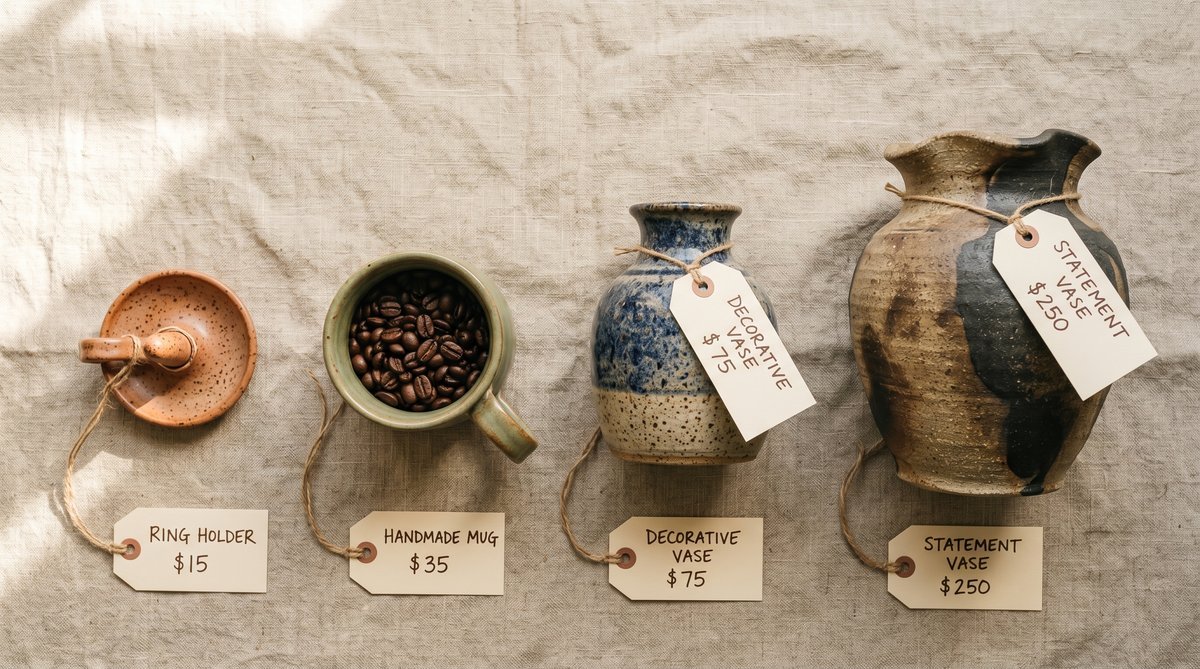
If you only stock items at $12-$25, two things go wrong. First, you have no anchor, so buyers perceive your low prices as low-quality rather than accessible. Second, you cap your per-customer revenue at $25. Add a single $150 piece to your display and average ticket size climbs, even when the $150 piece itself rarely sells.
The other side of this is glaze and finish. Buyers who are about to spend $200 want to see craftsmanship, and the cheapest place to lose them is at the glaze. If you are still calibrating your finishes, our guide to glazing techniques that produce market-ready pieces covers the difference between functional and merely fired.
Best pottery items by market type and season
Not every market wants the same pottery. Arts and craft fairs draw design-conscious buyers with higher discretionary budgets. Farmers markets draw practical buyers with lower price ceilings, where the sweet spot is closer to $30-$50. Holiday markets draw gift shoppers with a specific recipient in mind. The American Craft Council’s reporting on craft fair culture shows just how broad the audience range is, from collectors to first-time browsers.
| Item | Best Market Type | Best Season | Typical Price | Notes |
|---|---|---|---|---|
| Mugs | All markets | Year-round | $25-$65 | Top seller everywhere. Stock variety. |
| Ring holders / small novelty | Farmers, craft | Summer | $12-$20 | Gateway items. Impulse buys. |
| Soap dishes | All markets | Year-round | $18-$28 | Pair with handmade soap vendors if possible. |
| Bud vases | Farmers, craft | Spring, summer | $20-$35 | Sell well next to flower vendors. |
| Large vases | Craft fairs | Fall, holiday | $150-$350 | Anchor your display. Gift-buyers and collectors. |
| Serving bowls | Craft, holiday | Fall, holiday | $60-$150 | Larger sizes for Thanksgiving and Christmas hosts. |
| Everyday bowls | All markets | Year-round | $25-$50 | Steady seller. Cereal, ramen, ice cream sizes. |
| Plant pots | Farmers, craft | Spring, summer | $22-$65 | Drainage matters. Pair with plant vendors. |
| Spoon rests | All markets | Year-round | $15-$22 | Easy gift add-on at checkout. |
Read this table as a stocking guide, not a rule. The single most useful habit you can build is to track your own sales by market type and season with a basic point-of-sale app on your phone. After two or three markets you will have data nobody else has: yours.
The seasonal planning calendar: what to make and when
Pottery does not appear when you need it. The clay-to-customer pipeline runs four to six weeks at minimum: throwing or hand-building, drying (sometimes ten days alone), bisque firing, glazing, final firing. Miss your window and you are taking last summer’s leftovers to this summer’s markets.
Since it is mid-May 2026, here is how the calendar should already look:
- Right now (April-May): finishing the summer batch. Heavy on mugs, gateway items, bud vases, plant pots, soap dishes. Your June and July markets are about to start.
- June-July: selling, restocking the bestsellers, taking notes on what is moving and what is sitting.
- August-September: shift production to fall and holiday inventory. Large bowls, serving pieces, larger vases, lidded jars, pumpkin and gourd forms if you make seasonal work.
- October-November: peak holiday market season. The work you are selling now was made in August.
- December-January: recover, do inventory, plan next year’s clay orders.
A POS system that tracks SKUs will quietly transform your business. After one full season you will know that your speckled satin mugs outsell your matte black mugs three to one, that your $32 mugs outsell your $48 mugs by volume but not by revenue, and that ring holders sold out by 11 a.m. at your last two markets. Use that data to plan production runs. If you are still choosing your production clay, our breakdown of clay bodies suited to repeatable production runs covers what handles volume work without surprises.
One more piece of the planning puzzle: tooling. Production runs reward consistent tools. A good guide to the tools needed to make these market staples will save you the agony of throwing 40 mugs with the wrong rib.
What to skip: pottery that rarely sells at markets
Every potter has made these and watched them sit through three markets in a row. Save yourself the kiln space.
- Purely decorative sculptural pieces. Beautiful, admired, photographed, rarely purchased. The buyer cannot picture where it goes in their home.
- Teapots. Stunning to make. Almost nobody at a Saturday market brews loose-leaf tea, and the ones who do already own a teapot they love.
- Dinnerware sets. Buyers want eight matching plates or none at all. Making sets ties up weeks of production for a single sale, and any cracked piece breaks the set.
- Highly niche forms that need explanation. Yunomi, chawan, kohiki dishes. If you have to explain what it is, you have already lost two-thirds of the table.
- Oversized one-of-a-kind work. Better suited to galleries or online sales channels where the right buyer can find you than a 10-by-10 booth.
A useful nuance from longtime potters writing in community discussions of which pottery sells well: functional alone is not the answer. A mug only sells if it is pleasing to hold, glazed in colors people actually want in their kitchens, priced honestly, and stylistically distinct from the booth next door. Three identical white mugs across three booths cancel each other out. One mug with a personality wins all three sales.
Style is the moat. If your work looks like everyone else’s, you compete on price and lose. If your work looks like yours, you set the price. The cheapest way to develop a recognizable style is to glaze on purpose: pick three glaze combinations and commit, rather than running 40 tests across your inventory. Buyers remember a booth that has a look.
And if you are wondering how this work might appreciate over time, our piece on how to value antique and collectible pottery is a useful mirror: the pieces that hold value decades later are the ones with a clear maker’s voice, not the generic ones.
FAQ
How much should I charge for pottery at a craft fair?
Price based on a ladder, not a single number. Gateway items belong between $12 and $25, your main volume between $25 and $50, aspirational pieces between $75 and $150, and at least one anchor piece above $200. As a quick rule, materials and firing cost should be 15-25% of your retail price, leaving room for labor, booth fees, and the margin you actually take home. Farmers markets cap lower (around $50 for most sales) than arts fairs (where $100+ tickets are normal).
What is the best-selling pottery item at markets?
Mugs. Across nearly every public sales report from working potters, including Meesh Pottery’s 2024 data, mugs lead by a wide margin. They sell to gift-buyers, regulars, tourists, and the casual browser who came for tomatoes and left with a coffee cup. Price them between $25 and $65, stock visual variety, and they will pay your booth fee at almost every market.
Do mugs sell well at craft fairs?
Yes, consistently better than any other single item. The combination of daily use, gift-giving potential, and a price point most buyers can justify makes mugs the workhorse of any pottery booth. The one caveat: a generic mug at $35 will sit while a distinctive mug at $35 flies. Style matters more than function alone. Glaze, handle shape, and weight in the hand do the heavy lifting.
What pottery is easiest to make and sell?
Small functional items: ring holders, spoon rests, soap dishes, and sponge holders. These take minutes to form, fit many per kiln load, glaze quickly, and sell for $12-$25. Profit per hour of labor is often higher than on mugs, especially once you batch your production. They also serve as gateway items that pull first-time buyers into your booth and warm them up for larger purchases.
How do I increase my pottery sales at a market?
Three moves work fastest. First, build a price ladder from $12 to $250+ so every visitor can find something in range. Second, add an anchor piece (a $200+ statement vase or bowl) to reframe everything else as accessible. Third, track sales by SKU with a POS app so your next production run is shaped by real demand, not guessing. Booth height, lighting, and signage also matter more than potters tend to think.
Is pottery profitable to sell at markets?
It can be, but only with a clear pricing structure and disciplined production. A working potter selling 25-40 pieces at a strong weekend market with an average ticket of $35-$45 can clear $800-$1,800 after booth fees. The math falls apart fast if you underprice, skip the gateway items, or run a booth with no anchor piece. Profitability is a function of price architecture and stock mix, not luck.