
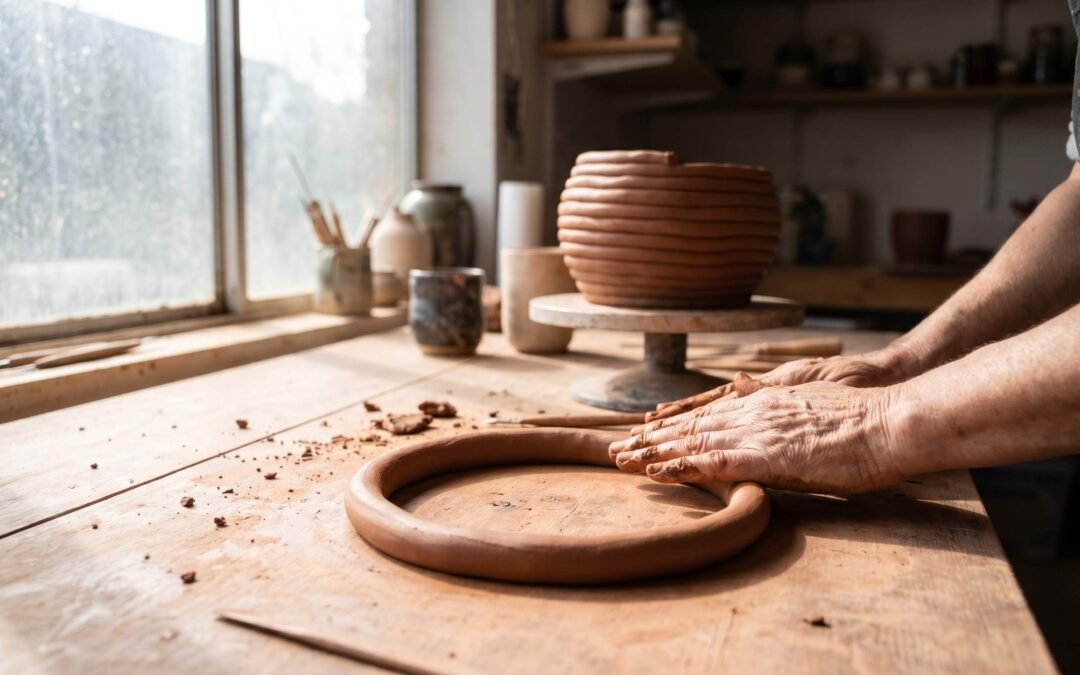
Coil Pottery: Step-by-Step Guide to Hand-Building Techniques
Coil pottery is the oldest reliable way to build a pot from scratch, and it still produces some of the most striking ceramic work being made today. If you want to learn a technique that needs no wheel, scales from a tea bowl to a four-foot vessel, and gives you total control over form, this is where to start. We walk through clay selection, the actual build, the joining methods that hold up best, and how to troubleshoot the failures every new coiler runs into.
What Is Coil Pottery?
Coil pottery is a hand-building technique where you form vessels by rolling clay into long ropes, stacking them in spirals or rings, and smoothing the joins to create solid walls. It requires no wheel, suits clays from earthenware to stoneware, and lets you build forms of nearly any size or asymmetry. The method is one of the oldest in ceramics, predating the potter’s wheel by thousands of years.
The technique appears in virtually every clay tradition on earth. Pueblo potters in the American Southwest, Jōmon makers in ancient Japan, West African storage-jar builders, and pre-Columbian artists in South America all relied on coiling. The fact that coiling dates to the Early Neolithic era tells you something important: when humans needed to make functional vessels without any specialized equipment, this is the method that worked. It still does.
What separates coil pottery from other hand-building pottery techniques is the relationship between speed, scale, and control. Pinch pots are faster but cap out small. Slab work suits geometric forms but struggles with curves. Coiling gives you organic shapes at any scale, and you can pause mid-build, walk away, come back, and keep going. That flexibility is part of why it has survived ten thousand years.
Coil Pottery vs. Wheel Throwing: When to Use Each
Wheel throwing gets the spotlight in most pottery studios, and it deserves it for what it does well: producing symmetrical, repeatable forms quickly. But coiling beats throwing for several specific situations, and knowing which to pick saves you days of frustration.
Coil when you want:
- Scale. Anything over about 14 inches tall is brutal on the wheel. Coiling has no upper limit. Large floor vases, garden pots, and sculptural vessels are coil territory.
- Asymmetry. Oval, lopsided, or organic shapes are nearly impossible to throw cleanly. Coils handle them naturally.
- Heavy texture. The seams between coils invite surface treatment. You can leave coils visible, carve into them, or smooth them flat depending on the look you want.
- Slow, considered work. Coiling is meditative. You build at the pace of thought, not the pace of a spinning bat.
- No wheel access. A kitchen table, a bag of clay, and your hands are enough to start. No studio required.
Throw when you want:
- Speed and repeatability. A skilled thrower can produce six identical mugs in the time it takes to coil one.
- Tight symmetry. Functional dinnerware looks best when the rims are level and the walls are even.
- Thin, refined walls. Throwing pulls clay thin in ways coiling cannot match without significant additional work.
One technique does not replace the other. Many experienced potters do both, often in the same piece. A wheel-thrown base topped with coils gives you the symmetry of throwing and the scale of coiling. Combining coiling with wheel-thrown components is a hybrid approach worth studying once you have the basics down.
Tools and Materials for Coil Pottery
The starter kit for coil work is small. Most of what you need probably exists in your kitchen or garage already.
Clay (the most important choice). Pick clay with grog or a coarse texture. Grogged stoneware is the gold standard for coil pottery because the grog (small pre-fired clay particles) gives the clay tooth, structure, and crack resistance. The grog also reduces shrinkage, which matters when you have multiple joins per piece.
Avoid smooth porcelain for your first coil projects. Porcelain is unforgiving: it dries fast, cracks at the seams, and has almost no structural strength when wet. Once you have built ten or fifteen successful coil pots in stoneware, you can attempt porcelain with a better sense of how to keep it alive. For a deeper breakdown of clay options, see our guide to types of pottery clay, and if you are just starting out, the best clay for beginners guide narrows it down further.
Tools you actually need:
- A wooden or metal rib for smoothing walls
- A serrated rib or fork for scoring joins
- A small pointed tool (a needle tool or even a bamboo skewer) for fine work
- A wire cutter to slice coils off the block
- A small container of slip (or just water plus a bit of mashed clay)
- A spray bottle for misting
- A banding wheel if you have one, or a sturdy flat surface
- Plastic sheeting (dry cleaner bags work) to slow drying between sessions
That is genuinely it. You do not need a kiln in your home (community studios and schools fire pieces for a modest fee), and you do not need a wheel. For a fuller rundown of what belongs in a starter studio, the essential pottery tools guide covers every stage.
How to Make a Coil Pot: Step-by-Step
Here is the build process for a basic coil pot, roughly mug to small vase sized. The same steps scale up; you just add more coils and more rest time.
Step 1: Wedge your clay
Wedge for at least three minutes to remove air pockets and align the clay particles. Skipping this step is the single most common reason beginner pots crack or explode in the kiln. Wedge until the clay feels uniform under your hands and has no marbled streaks.
Step 2: Form the base
Pat or roll a slab about a quarter-inch thick. Cut it to the diameter you want for your pot’s base (somewhere between 3 and 5 inches for a starter project). Place the base on a piece of cloth or plastic so you can rotate it without picking it up directly.
Step 3: Roll your first coils
Take a chunk of clay roughly the size of a small fist. Press it into a rough rope shape with your palms first, then roll it on a clean, smooth surface using flat hands and even pressure. Work outward from the center, keeping fingers wide and relaxed. The coil should be even from end to end, somewhere between half an inch and three-quarters of an inch in diameter.
If the coil flattens into a ribbon or starts cracking on the surface, the clay is too dry. Add a little water and re-wedge. If it sags or stretches, it is too wet. Let it sit uncovered for ten minutes and try again.
Step 4: Score and slip the base edge
Use a serrated rib or fork to scratch the top edge of your base where the first coil will sit. Brush on a thin layer of slip. The scoring creates mechanical tooth, the slip is the adhesive. Both matter.
Step 5: Lay the first coil
Press the coil onto the scored base, starting from one point and circling around. Where the two ends meet, pinch them firmly together and smooth the join. Trim any excess.
Step 6: Blend the interior
Working from the inside, drag clay downward from the coil into the base. Use your thumb or a wooden tool. The coil should disappear visually on the interior, becoming one continuous wall with the base. On the exterior, you can leave the coils visible as a decorative element or smooth them flat as you go. The interior must always be blended.
Step 7: Repeat and build height
Score and slip the top of each coil before adding the next. Stack and blend, stack and blend. Every three or four coils, stop and check the wall thickness; press firmly enough that the walls compact but not so hard that they collapse outward.
Step 8: Rest between sections
If your pot is taller than about six inches, the lower walls need to firm up before they can support more weight. Cover the lower section loosely with plastic and let it stiffen for 20 to 60 minutes while you work on something else or roll more coils.
Step 9: Finish the rim
The top coil is the rim. Take your time here. Smooth it cleanly, compress it with a rib (compressing the rim helps prevent cracks later), and add any final shaping.
Step 10: Dry slowly, then fire
Cover the finished pot loosely with plastic for two or three days, then uncover and let it bone-dry for another two or three. Slow drying is non-negotiable for coil work. Once bone dry, the piece is ready for bisque firing, after which you can move on to glazing your finished piece.
Joining Techniques Compared
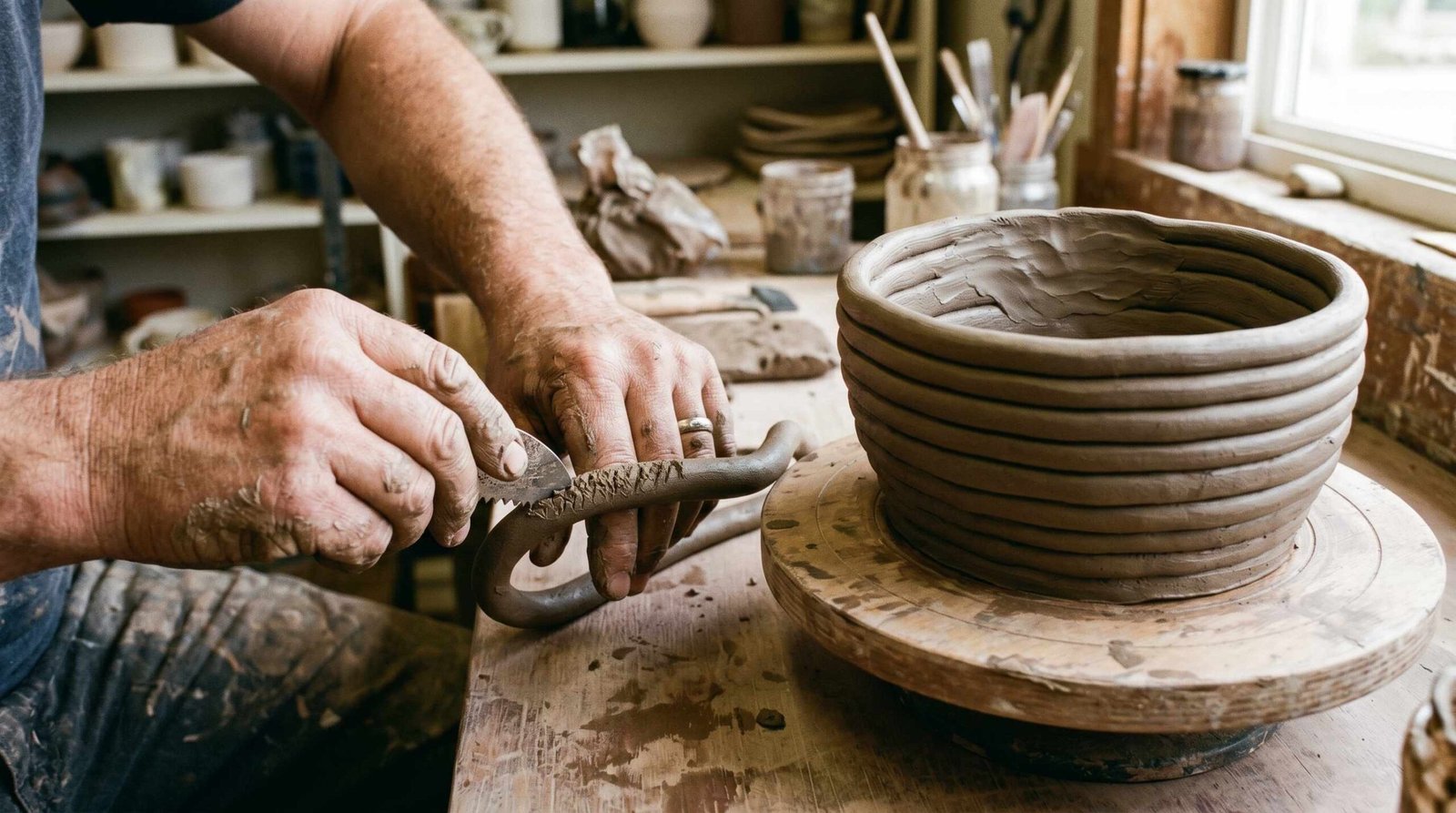
How you join coils determines whether your pot survives drying and firing. Three approaches dominate, and they are not equally reliable. Here is the comparison.
| Method | How it works | Best for | Risk of cracking |
|---|---|---|---|
| Score-and-slip only | Scratch both surfaces with a serrated tool, apply slip as adhesive, press coils together. No further blending on either side. | Decorative pieces where visible coil seams are the design intent. Small, low-stress vessels. | High. Without interior blending, water travels through the seams and shrinkage pulls them apart during drying. |
| Blending interior only | Lay coils with light contact pressure, then drag clay downward from each new coil into the one below on the inside. No scoring or slip. | Quick, casual work and small pieces. Sculptural forms where the inside will not hold liquid. | Medium. Works for short pieces but lacks the mechanical lock for taller walls or functional vessels. |
| Score-and-slip plus interior blend | Score and slip both surfaces, press coils together firmly, then blend the interior thoroughly. Optional: blend exterior too. | Functional pots, tall vessels, anything that will hold water or face temperature changes. The default for serious work. | Low. Combines mechanical bond, chemical adhesion, and structural continuity. This is the method we suggest for all but the most decorative pieces. |
If you only remember one thing from this section: score and slip both surfaces, and blend the interior. That combination is what holds coil pots together through years of use.
Why Coil Pots Crack and How to Prevent It
Coil pottery has three signature failure modes. Once you can identify which one is happening, you can fix it.
Seam cracking
You see hairline cracks running horizontally along the lines where coils meet. The pot might survive drying but cracks open during bisque firing, or worse, comes out of the glaze fire with a clean break along an old seam.
The fix: Score deeper. Most beginners barely scratch the surface. Use a serrated rib or fork and create visible texture, like the tines of a comb leaving lines. Apply slip generously to both surfaces, not just one. Then press the coils together with firm pressure and blend the interior thoroughly. Compression at the join is what locks the bond. If you are still getting seam cracks, your clay is probably too dry when you are adding coils. Mist with water and work faster.
Walls leaning or collapsing
You build up four or five coils and the whole thing starts to bulge outward, or worse, tips sideways under its own weight.
The fix: Rest periods. Tall coil pots cannot be built in a single sitting. The lower walls need to firm up to leather-hard before they can support the upper walls. Build three or four coils, then cover the lower section with plastic and walk away for half an hour. Come back and continue. For pieces over a foot tall, you may need to build over several days.
The second cause is wall thickness. Walls that are too thin at the bottom cannot hold weight above them. Keep the lower third of your pot slightly thicker than the upper portions, the same way a tree trunk tapers upward.
Uneven coil thickness
Your pot looks wobbly. The walls are thicker on one side, the rim is lopsided, and the whole piece feels uncomfortable in the hand.
The fix: Roll more deliberately. Use flat palms, not curled fingers. Apply even pressure from end to end of the coil, and roll outward from the center rather than back and forth. Some potters cut their coils to a measured length and weigh each one for consistency. That is overkill for casual work, but for matched sets, it helps.
The other cause is rushing the smoothing step. After laying each coil, take a beat to check that it is sitting level. A small adjustment now prevents a wobble that compounds with every coil above it.
Beginner Projects to Start With
These projects build skills progressively. Each one teaches something the next one will demand.
1. Cylinder vase (difficulty: easy). A straight-walled cylinder, six to eight inches tall. No curves to fight, no tapering, just clean vertical walls. This teaches you coil consistency, scoring and slipping rhythm, and pacing. Most first coil pots should be cylinders. Aim for walls about three-eighths of an inch thick.
2. Bowl with flared rim (difficulty: easy). Start with a base around five inches wide and let the coils spiral outward, each one slightly larger in diameter than the one below. You are building a shallow bowl, perhaps three inches tall with an eight-inch rim. This teaches you to control diameter as you go.
3. Pinched-in vase (difficulty: medium). A vessel that bulges in the middle and narrows toward the top. The trick is pulling the coils inward as you build the shoulder. This teaches you how to make the clay change direction without collapsing.
4. Lidded jar (difficulty: medium). A short, wide-mouthed jar with a fitted lid. The lid is its own small coil project, and the rim of the jar needs to be flat and even for the lid to sit properly. This teaches precision and planning.
5. Tall floor vase (difficulty: hard). Eighteen to twenty-four inches tall. Built over three or four sessions with rest periods between. This is your graduation project from beginner to intermediate. You will use everything you have learned.
6. Sculptural figure or organic form (difficulty: hard). Coil pottery does not have to make functional vessels. Build an animal, a face, an abstract sculpture. The coil method handles asymmetry beautifully, and you can leave the coils visible as part of the surface texture.
Advanced Coil Techniques Worth Exploring
Once you have a dozen successful coil pots behind you, these techniques open up new possibilities.
Visible coil aesthetics. Instead of smoothing the exterior flat, leave the coils visible. Press them gently to flatten the outer profile but keep the spiral pattern as a surface feature. Pueblo potters and many contemporary artists use this approach to celebrate the building method rather than hide it.
Combined coil and slab. Build a slab base or lower section, then transition to coils for height and curves. This works well for vessels with a flat front face and a coiled back, or for any geometric-meets-organic form.
Combined coil and wheel. Throw the bottom third on a wheel for symmetry, then coil upward to add scale or asymmetry. This is the technique referenced earlier in our discussion of hybrid forms. The wheel-thrown foundation gives you a clean, even start, and the coils let you build forms that would be impossible on the wheel alone.
Coil and pinch. Add small pinched elements (handles, spouts, decorative knobs) to a coiled body. The pinch elements complement coils nicely because both are hand-building methods, so the visual vocabulary stays consistent.
Carved coil surfaces. While the pot is leather-hard, carve through the outer wall to reveal a deeper layer of clay or to create raised patterns. The coil structure gives you natural lines to carve along.
Burnished surfaces. Coil pots take beautifully to burnishing, the technique of polishing leather-hard clay with a smooth stone or the back of a spoon. The result is a soft sheen with no glaze needed. Many ancient coil pots were burnished and pit-fired with no glaze at all.
Pit firing. Coil pots in red earthenware or terracotta can be pit-fired (an outdoor fire surrounded by combustibles) for surfaces that show flame markings and smoke patterns. This is the original firing method for coil work and produces results no kiln can replicate.
FAQ
Do I need a pottery wheel to make coil pots?
No. Coil pottery is a hand-building technique that requires only your hands, basic shaping tools, and a flat work surface. A banding wheel is helpful for rotating your piece but is not essential. This is one of the oldest and most accessible methods of forming clay, dating back roughly 10,000 years.
How thick should my coils be?
For most projects, aim for coils between half an inch and three-quarters of an inch in diameter. Thinner coils suit small vessels and detailed work, while thicker coils support larger sculptural forms. Consistency matters more than absolute size: uneven coils lead to leaning walls and uneven drying.
What is the best clay for coil pottery?
Grogged stoneware is the best all-around choice for coil work. The grog (pre-fired clay particles) adds structural strength, reduces shrinkage, and minimizes cracking at the joins. Smooth porcelain is harder to coil successfully because it has less tooth and dries unevenly. If you are choosing your first bag, lean toward a mid-range stoneware with visible grog.
How long does it take to build a coil pot?
A small mug-sized coil pot takes about one to two hours of active work, though it may need to rest between sections so lower walls firm up enough to support upper ones. Larger vessels can take several days from start to bone dry, with rest periods built into the build. For a floor vase or tall sculptural piece, plan on at least three or four sessions across a week.
Can you throw on a wheel and coil in the same piece?
Yes, and it is a powerful approach for ambitious forms. Many potters throw a base on the wheel, then add coils on top to build height or width that would be impossible to throw in a single pull. The wheel-thrown foundation gives a clean, symmetrical start and the coils let you push scale. This hybrid method is increasingly common in contemporary studio work.
Why do my coil pots keep cracking?
The three most common culprits are poor joining (failing to score and slip both surfaces), uneven drying (one section dries faster than another), and clay that is too dry when you join new coils. Slow drying under loose plastic and consistent moisture during the build solve most cracking problems. If you have addressed all three and are still cracking, look at your wedging: trapped air pockets cause cracks too.
Can coil pots hold water?
Yes, once properly fired and glazed. A bisque-fired and glaze-fired coil pot is just as watertight as a wheel-thrown one, as long as the joins were made correctly during the build. For functional vessels, always use the score-and-slip-plus-interior-blend joining method. Test a finished piece by filling it with water and letting it sit overnight before committing to a use case like a vase or pitcher.
Should I smooth the coils flat or leave them visible?
That is an aesthetic choice. Smoothing produces a clean, uniform surface that reads more like a thrown pot. Leaving coils visible celebrates the building method and gives the piece a distinct hand-built character. Many of the most admired coil potters working today, both contemporary and within traditional lineages, choose to keep at least some coil texture visible. Try both on your early pieces and see which look you connect with.