
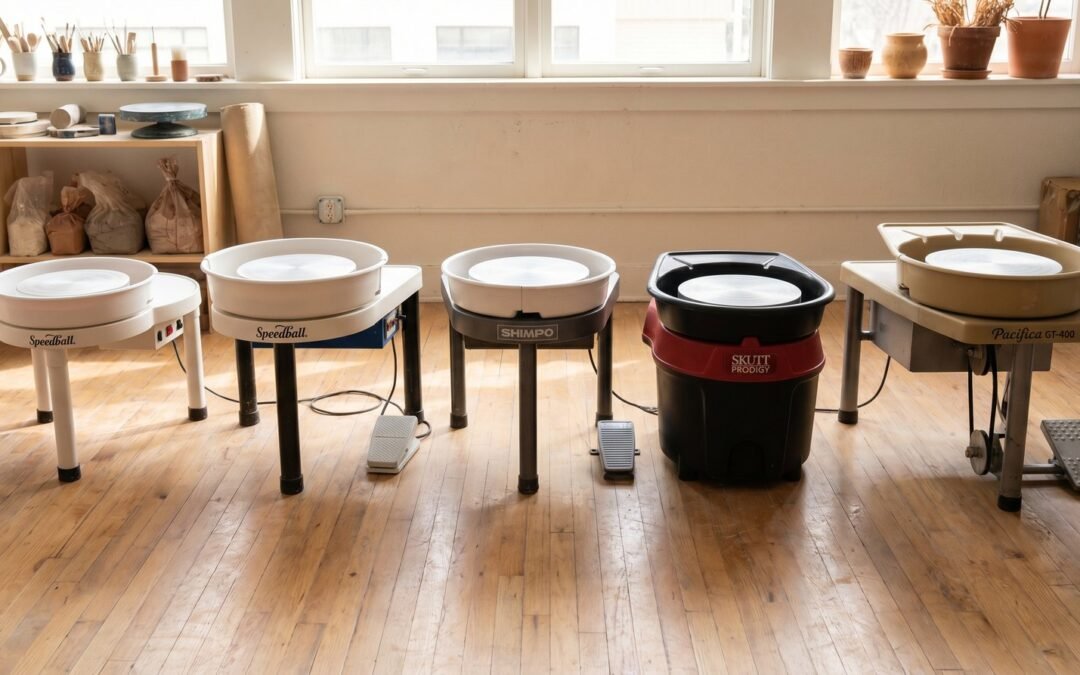
The right pottery wheel for a beginner is one you will actually want to throw on after the novelty wears off. Quick answer: most beginners are best served by a $400 to $1,200 mid-tier wheel from Speedball, Shimpo, Skutt, or Pacifica. Below $400 you get fragile off-brand wheels that fail within a year. Above $1,500 you get professional-grade machines that beginners will not use to their potential. The sweet spot is the $600 to $1,000 range where the build quality, motor torque, and feature set match what a serious beginner actually needs.
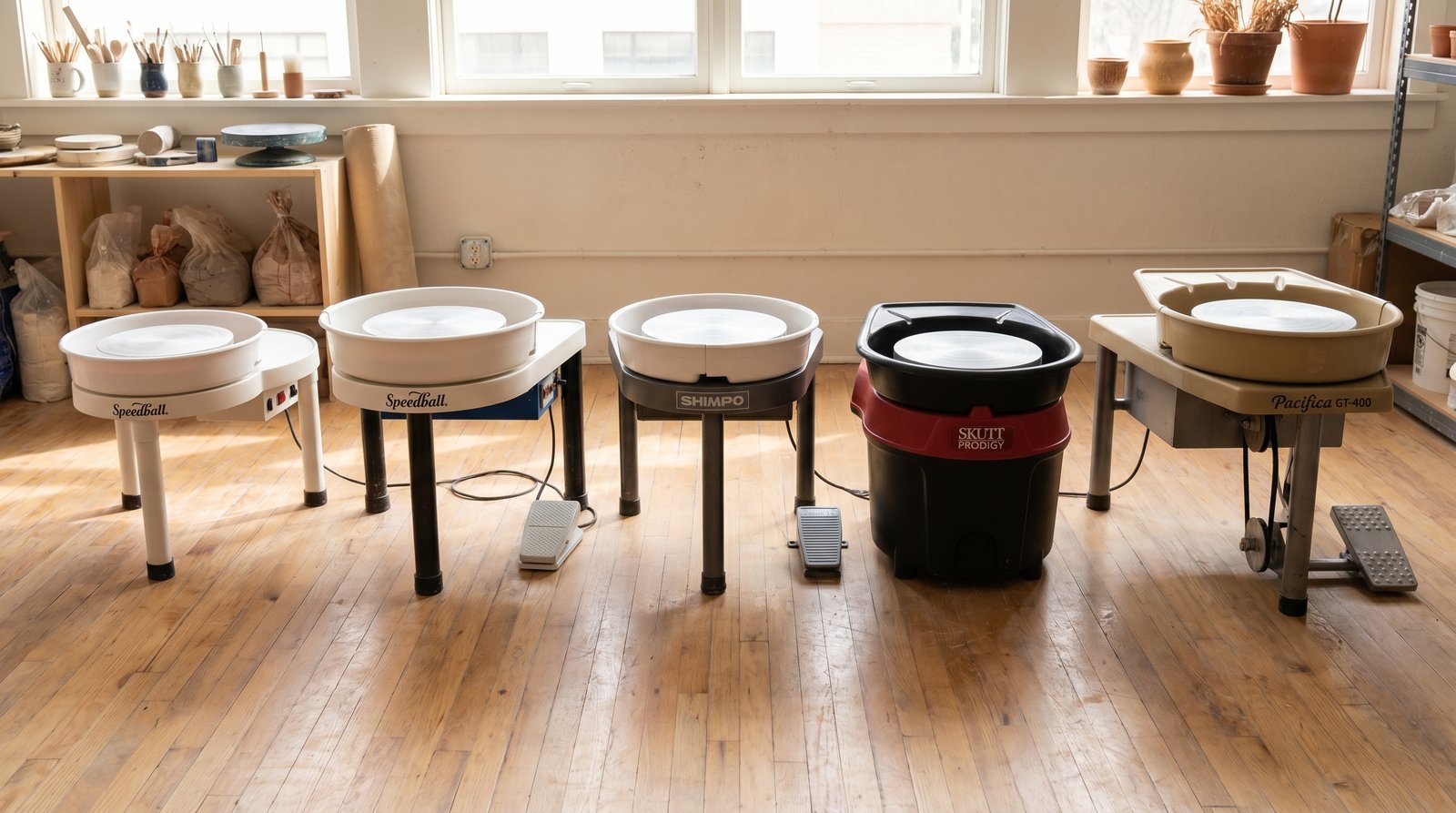
This guide walks through the five wheels we suggest for new potters in 2026, with real current prices, what each wheel is genuinely good at, and the trade-offs that matter. If you are still trying to decide whether a wheel is worth the investment at all, our breakdown of how much a pottery wheel costs in 2026 covers the full price landscape including used market deals and total cost of ownership.
What to Look For Before You Buy
Before comparing specific models, decide what actually matters for your setup. The wrong wheel is one that does not fit your space, your budget, or your throwing ambitions. The right one disappears under your hands and lets you focus on the clay.
Motor power and torque
Motor horsepower drives how much clay the wheel can center without bogging down. Beginner-tier wheels run 1/3 to 1/2 HP. That handles 5 to 25 pounds of clay comfortably. The trick: the rating is centering capacity under load, not static weight. A potter pressing down on a 15 pound piece during centering stresses the motor like 100+ pounds of static load. Pick a wheel rated for at least 3 to 5 times the largest piece you plan to throw.
Wheel head size
11 to 12 inch heads work for cups, mugs, and bowls. 14 inch heads give you room for bats and larger plates. A 14 inch head is more forgiving when you trim or work off-center.
Reversing motor
Most US potters throw counter-clockwise. Left-handed potters and traditional Japanese-style throwers need clockwise rotation. A reversing motor means you can switch direction. If you are right-handed and throwing US-style, the feature does not matter much. If you are left-handed, do not skip it.
Splash pan
A removable splash pan catches water, slurry, and trim shavings. Cheap wheels skip it or use a fragile plastic version that cracks. The pan saves you from cleaning the floor after every session.
Build quality
Plastic bodies feel cheap because they are cheap. Steel frames and cast iron bases last decades. The cheap tells: thin pressed metal, plastic splash pans, single-speed motors, no warranty over one year.
The Five Beginner Wheels Worth Considering
These are the five wheels real pottery teachers and studio owners suggest for new throwers. Each is built for actual longevity, not a one-season hobby.
Speedball Artista, about $400 to $599 (best for tight space)
The Artista is a tabletop wheel built for makers who do not have a permanent studio. Despite its compact size, it has a 1/3 HP motor, an 11 inch wheel head, and a 25 pound centering capacity. Speedball’s official Artista product page confirms it covers up to 25 lb pieces, which is more than most beginners ever throw.
The Artista is what pottery teachers haul to demo events. It sets up in 30 seconds, packs away into a closet, and survives years of transport. The trade-off: the 11 inch head limits bat options, and the table-top form factor means you are throwing at table height instead of seated at a full-size wheel. For apartment potters and demo work it is the right call. For a permanent home studio, a full-size wheel will feel more natural.
Pros: Portable, quiet, reliable, 5-year warranty.
Cons: Small head, table-top height, not great for throwing standing or in long sessions.
Best for: Apartment potters, pottery teachers, anyone with limited storage space.
Speedball Clay Boss, about $1,200 (best all-around mid-tier)
If we had to recommend one wheel to one beginner sight-unseen, the Clay Boss would be it. 1/2 HP industrial motor. 14 inch composite wheel head. 100 pound centering capacity. Quiet electronic speed control with load sensing that maintains RPM under varying pressure. Reversible. 10 year warranty.
The Clay Boss is built for the potter who is committed enough to want a real wheel but not yet doing production work. Sheffield Pottery’s buyer guide calls it one of the two best entry-level full-size wheels, paired in price and capability with the Shimpo VL-Lite.
Pros: Full-size build, real torque, quiet, parts available everywhere, hold value on used market.
Cons: Heavy at 95 pounds, not portable.
Best for: Serious home potters, anyone planning to upgrade only once.
Shimpo VL-Lite, about $1,100 (best for quiet workspace)
The VL-Lite is what you buy when you cannot make noise. Shimpo’s direct-drive motor is genuinely quieter than belt-driven competitors at every speed. 1/2 HP, 12 inch aluminum wheel head, 100 pound capacity. The smaller head is the main trade-off versus the Clay Boss; everything else is comparable. Reversible via a manual switch flip rather than a plug change.
Shimpo wheels also have a feature most beginners do not know to look for: the wheel head spins freely when the foot pedal is released. That makes coiling on top of a thrown form easier (you can rotate the piece by hand without fighting motor resistance). For potters who plan to make larger forms by combining throwing + coiling, the Shimpo design wins.
Pros: Quietest in the class, free-spinning head when pedal released, 5 year warranty.
Cons: 12 inch head smaller than Clay Boss, switch-flip reverse is awkward.
Best for: Apartment potters who need quiet, anyone combining throwing with coiling.
Skutt Prodigy, about $1,100 to $1,300 (best for compact full-size)
Skutt’s entry-level Prodigy uses a 1/3 HP motor with a clever gearing arrangement that punches above its weight, centering up to 75 pounds. 12 inch twist-and-lift wheel head, integrated full-size splash pan that covers the whole wheel base. Non-reversing.
The Prodigy is the most compact full-size wheel in the price range. The integrated splash pan keeps water and slurry contained better than removable designs. The trade-off is the non-reversing motor: left-handed potters and Japanese-style throwers should skip it.
Pros: Compact full-size footprint, integrated splash pan, Skutt build reputation.
Cons: Non-reversing, 12 inch head, smaller motor than competitors.
Best for: Right-handed beginners with limited studio space.
Pacifica GT-400, about $1,200 (best for value scaling)
Pacifica’s GT-400 is a step up from the entry-level wheels above without crossing into pro pricing. 13 inch machined aluminum wheel head, 80 pound centering capacity, reversing motor, and a foot pedal Pacifica calls the “Magic Pedal” that gives finer speed control than most competitors in this price range. 5 year warranty and 30 day satisfaction guarantee.
The GT-400 is what you buy when you suspect you will quickly outgrow a Clay Boss or VL-Lite but cannot stretch for a Brent Model C. It is genuinely mid-tier rather than entry-level, but the entry-level price.
Pros: Best speed control in class, aluminum wheel head, generous capacity.
Cons: Less common in studios so harder to test before buying.
Best for: Beginners who anticipate becoming intermediate within 12 months.
Quick Comparison at a Glance
| Model | Price | Motor | Wheel Head | Capacity | Reversing | Best For |
|---|---|---|---|---|---|---|
| Speedball Artista | $400-$599 | 1/3 HP | 11″ | 25 lb | Order direction | Tight spaces, demos |
| Speedball Clay Boss | ~$1,200 | 1/2 HP | 14″ composite | 100 lb | Yes (plug) | Best all-around |
| Shimpo VL-Lite | ~$1,100 | 1/2 HP | 12″ aluminum | 100 lb | Yes (switch) | Quiet work |
| Skutt Prodigy | $1,100-$1,300 | 1/3 HP | 12″ | 75 lb | No | Compact, right-handed |
| Pacifica GT-400 | ~$1,200 | 1/2 HP | 13″ aluminum | 80 lb | Yes | Value scaling |
How to Pick the Right One
The choice usually comes down to three questions.
Do you have permanent studio space?
No: Speedball Artista. The tabletop form factor and 30 second setup matter more than the wheel head size.
Yes: any of the four full-size wheels work. Pick on the next two questions.
Do you need quiet operation?
Yes (apartment, late nights, shared space): Shimpo VL-Lite. Direct-drive is noticeably quieter than belt-drive at every speed.
No: Clay Boss, Prodigy, and GT-400 are all in the same noise range as each other.
Are you left-handed or planning to throw Japanese-style?
Yes: Skip the Skutt Prodigy. Non-reversing motor will fight you on every throw. Clay Boss, VL-Lite, or GT-400 all reverse.
No: any of the five work for you.
What to Skip
The pottery wheel market has a bottom tier that should not exist. Off-brand wheels from Amazon (VEVOR, Mophorn, generic Chinese imports) are listed at $150 to $300 and look superficially similar to the wheels above. They are not the same machine.
The signals that you are looking at a wheel to skip:
- No US-based service or warranty support
- Replacement parts not available after year one
- Listed motor wattage but no actual HP rating
- Reviews that mention motor failure within 6-12 months
- Manufacturer name you have never seen in a pottery studio
If your budget tops out at $400, buy a used Speedball Artista or Shimpo VL-Lite on Facebook Marketplace before you buy a new off-brand. A 10 year old Shimpo VL works better than a new VEVOR will after six months.
Maintenance Basics for Beginners
All five of these wheels are designed to last a decade or more with basic care. The maintenance is straightforward:
- Wipe the splash pan and wheel head down after every session. Dried slurry buildup wears bearings prematurely.
- Keep electrical components dry. Splash pans contain most of the water, but errant drops can short controllers. Cover the controller during cleaning.
- Lubricate the wheel head shaft once per year per the manufacturer’s instructions. Brent, Shimpo, and Skutt all publish maintenance guides.
- Replace the foot pedal cord if it gets stepped on or cracks. The pedal is more often the failure point than the wheel itself.
Beyond the Wheel: What Else You Need to Get Started
A wheel is roughly half of what a working pottery studio costs. Plan to also budget for clay (about $30 to $50 per 25 lb box), 8 to 12 bats, a basic throwing tool kit ($50 to $150), glazes, and either a kiln or kiln rental at a local studio. Our breakdown of why pottery wheels are so expensive covers the full economics of building out a studio. For the firing side, see our guide on how to fire pottery.
And before you spend a thousand dollars on a wheel, consider taking a beginner class at a local studio first. Most run $150 to $300 for a 6 to 8 week course and you will know within a month whether the craft suits you. For potters who decide it does and want to start selling their work, our guide to how to sell pottery online walks through the full setup-to-first-sale path.
Frequently Asked Questions
What is the cheapest decent pottery wheel?
The Speedball Artista at around $400 to $599 is the cheapest wheel from a reputable manufacturer that will last beyond the first year. Below that price you are in the off-brand territory where motor failures within 6 to 12 months are common.
Is a kick wheel better than an electric wheel for beginners?
No. Kick wheels are heavier, harder to control, and physically demanding. They are a craft preference, not a beginner-friendly choice. Almost every modern pottery class teaches on electric wheels.
How long does a pottery wheel last?
A quality wheel from Speedball, Shimpo, Skutt, Pacifica, or Brent will run 10 to 30 years with basic maintenance. Off-brand wheels typically fail within 3 to 7 years.
Can I buy a used pottery wheel for my first one?
Yes, and we suggest it if your budget is tight. A used Speedball Artista or Shimpo VL-Lite from Facebook Marketplace will outperform any new off-brand wheel for the same price. Inspect the wheel under load before buying (any lag, smell, or weird noise is a hard pass).
What size wheel head do I need?
For mugs, bowls, and standard functional pottery, an 11 to 12 inch head is fine. For plates, larger bowls, or using bats wider than your wheel head, choose 14 inches.