
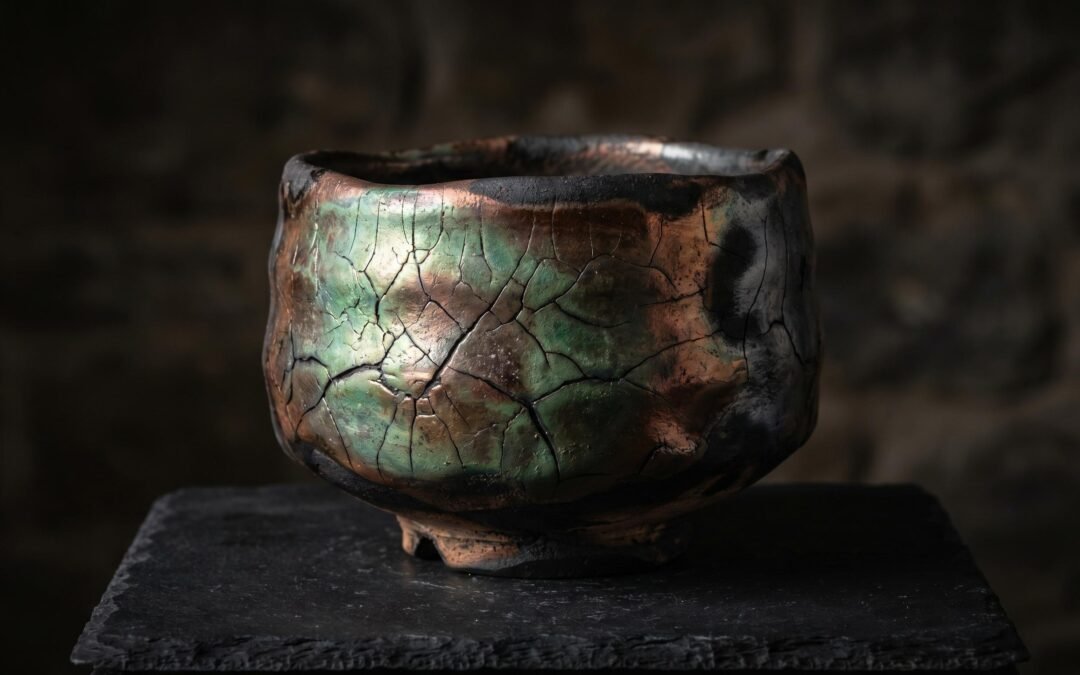
Raku Pottery: A Complete Guide to Japanese Origins, Modern Technique, and Getting Started
Raku pottery is a low-fire ceramic technique originating in 16th-century Japan, where pots are removed from the kiln while glowing red-hot and either air-cooled (traditional Japanese style) or placed in a reduction chamber filled with combustibles (Western style). The unpredictable fire, smoke, and rapid cooling create one-of-a-kind glazes impossible to replicate.
What Is Raku Pottery?
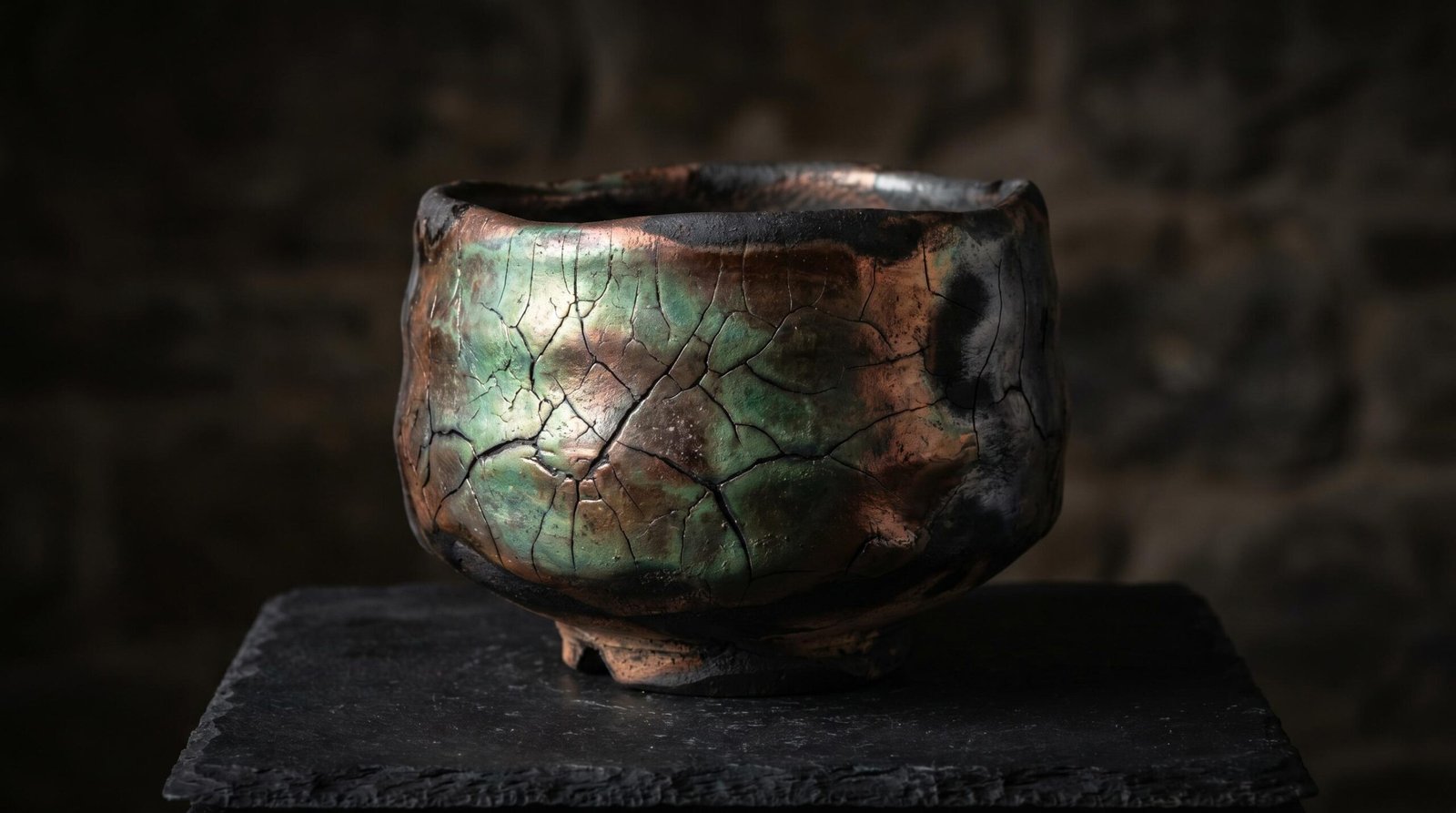
Raku is a family of low-fire ceramic techniques defined by what happens after the kiln door opens, not what happens inside it. While conventional pottery cools slowly over many hours, a raku piece is pulled from the kiln glowing orange-red and either left to cool in open air or dropped into a metal can full of combustibles. That sudden change is the whole point of the craft.
The name comes from the Japanese character 楽 (raku), which translates roughly to “enjoyment,” “ease,” or “comfort.” It was originally a personal seal granted to one family of potters by a 16th-century warlord, and the word eventually became the generic name for a style of tea bowl, then later for a broader set of techniques. The tea bowls produced this way (chawan) became central to the Japanese tea ceremony because their hand-shaped, irregular forms suited the wabi aesthetic of restraint, imperfection, and quiet attention that tea master Sen no Rikyu was championing.
Every raku piece is genuinely unique. The combustibles smoke differently every time. Glazes crackle in patterns no potter can plan. Carbon settles into the unglazed clay in ways that depend on wind, fuel, timing, and chance. For potters who spend most of their time controlling for consistency, raku is the technique they turn to when they want to let go.
A Brief History of Raku, From Japan to Your Backyard
The story begins in late 16th-century Kyoto. The tea master Sen no Rikyu, who was redefining Japanese tea ceremony around principles of simplicity and humility, commissioned a tile-maker named Chojiro to produce tea bowls that matched his aesthetic. Chojiro shaped his bowls entirely by hand (never on a wheel), giving them the asymmetric, intimate feel Rikyu wanted. These bowls were fired at low temperature in a small kiln and pulled out hot to cool quickly.
When the warlord Toyotomi Hideyoshi granted Chojiro’s son a gold seal bearing the character 楽 (raku), the family name and the technique fused. The Raku ware dynasty has now continued for sixteen generations, with each Raku family head preserving and slowly evolving the tradition.
The technique stayed almost exclusively Japanese for three centuries. In 1911, the British studio potter Bernard Leach witnessed a raku firing during his time in Japan and brought descriptions of it back to the West. But the real Western explosion came almost fifty years later, when the American ceramicist Paul Soldner began experimenting with raku in the late 1950s at the Otis Art Institute in Los Angeles.
Soldner’s innovation in the 1960s was the post-firing reduction chamber, which Japanese raku had never used. He found that placing the red-hot pot into a metal can filled with sawdust, leaves, or newspaper produced metallic lusters, deep blacks, and dramatic crackle patterns nothing in traditional Japanese practice could match. That single move turned raku from a quiet tea-ceremony tradition into a vivid, theatrical Western art form.
The two traditions have not always coexisted easily. At a 1979 craft conference in Kyoto, Soldner and the 14th-generation Raku family heir held a public discussion about whether Western potters should even use the word “raku.” Japanese traditionalists argued that work made by other makers should bear the maker’s own name, not the Raku family seal. The disagreement was respectful, but it pointed to a real tension: in Japan, “raku” is a family lineage. In the West, it became a generic term for a technique. Both meanings are now in circulation, and the word covers a much wider range of work than Chojiro ever made.
Traditional Japanese Raku vs. Western Raku
The two traditions share a common ancestor but diverge in almost every detail of practice. The table below summarizes the practical differences.
| Feature | Traditional Japanese Raku | Western/American Raku |
|---|---|---|
| Shaping method | Hand-molded | Wheel-thrown or hand-built |
| Glaze firing temp | ~800°C | 900-1000°C |
| Post-kiln treatment | Air-cooled outdoors | Reduction chamber (combustibles) |
| Color palette | Earthy, understated, wabi | Metallic lusters, vivid, varied |
| Food safety | Not food safe | Not food safe |
| Primary use | Tea bowls for ceremony | Art, sculpture, decorative vessels |
| Emphasis | Subtlety, restraint | Spontaneity, dramatic effects |
The deepest difference is philosophical. Japanese raku is a contemplative tradition: the same family makes the same kinds of bowls in much the same way across generations, with subtle innovation each cycle. Western raku is a performance: the firing is often a social event, the results are colorful and unpredictable, and the work is meant to surprise rather than soothe.
How Raku Firing Works (Step-by-Step)
The full raku process moves through five distinct stages. Each one matters, and skipping any of them will compromise the finished piece.
Step 1, Bisque Firing
Before a piece can be raku fired, it has to be bisque fired first. Bisque firing converts the raw clay into a stable, porous ceramic that can survive the thermal shock to come. For raku, the bisque is typically taken to around 900°C (cone 08). For a full breakdown of the bisque firing process, see our guide to bisque firing pottery.
If you skip the bisque firing and try to raku fire a green (unfired) pot, the rapid temperature climb will almost certainly cause the piece to explode in the kiln. Bisque first, always.
Step 2, Applying Raku Glazes
Raku glazes are formulated differently from standard pottery glazes. Because the pot is heated and cooled so quickly, the glaze has to withstand serious thermal shock without flaking off the surface. Most commercial raku glazes contain frits and fluxes that mature at low temperatures and have coefficients of thermal expansion close to those of a grogged raku clay body. For general glaze preparation, our pottery glazing for beginners guide covers the foundations.
Copper-based glazes are the classic choice for Western raku because copper reacts strongly with the oxygen-starved atmosphere of the reduction chamber, producing the metallic, iridescent, almost flame-like surfaces most people picture when they hear the word “raku.” Iron-based glazes give warmer earth tones. White crackle glazes produce a sharp black-and-white surface where the carbon from reduction settles into every tiny crack.
Step 3, Glaze Firing
The glaze firing climbs to 900-1,000°C, or cone 06 on the ceramic cone scale. This is far cooler than a stoneware firing (cone 10 hits roughly 1,280°C) and the whole process takes only 20-45 minutes once the kiln reaches temperature. Watch through the kiln peephole for the glaze melt: when the surface looks glassy and reflective and the pot is glowing bright orange, it’s ready to come out.
Speed is part of the appeal here. A typical stoneware firing takes 8-12 hours plus cooling. A raku firing can take you from cold kiln to finished pot in under two hours.
Step 4, The Reduction Chamber
This is the step that defines Western raku. With long steel tongs, lift the red-hot piece out of the kiln and place it inside a metal container (most potters use a galvanized steel garbage can) packed with combustibles: shredded newspaper, dry straw, sawdust, leaves, or pine needles all work. The combustibles ignite instantly on contact with the glowing pot.
Snap the lid shut. With oxygen sealed out, the burning material consumes the remaining air inside the can and switches from oxidation to reduction. Without enough oxygen to burn cleanly, the fire pulls oxygen out of the metal oxides in the glaze, leaving behind pure metal deposits. Carbon settles onto every unglazed surface and into every crack. This is where the metallic luster, the deep iridescence, and the smoke-blackened bare clay all come from.
Step 5, Cooling and Cleanup
After 5 to 15 minutes in the reduction chamber, lift the piece out. Some potters quench it in a bucket of water for an immediate hard cooling (this can sharpen crackle patterns), while others let it cool slowly in open air. Both work, and the choice affects the final surface.
Once the piece is cool enough to handle, scrub the unglazed areas with steel wool or an abrasive pad to remove the loose surface carbon. What stays behind is the smoke pattern fused into the clay itself, a soft grayscale gradient that no decorating tool could ever reproduce by hand.
Raku Styles and Variations
Within the broad Western raku umbrella, several distinct sub-styles have developed. Each one uses the same basic firing principle but produces dramatically different surfaces.
Traditional Copper Matte Raku
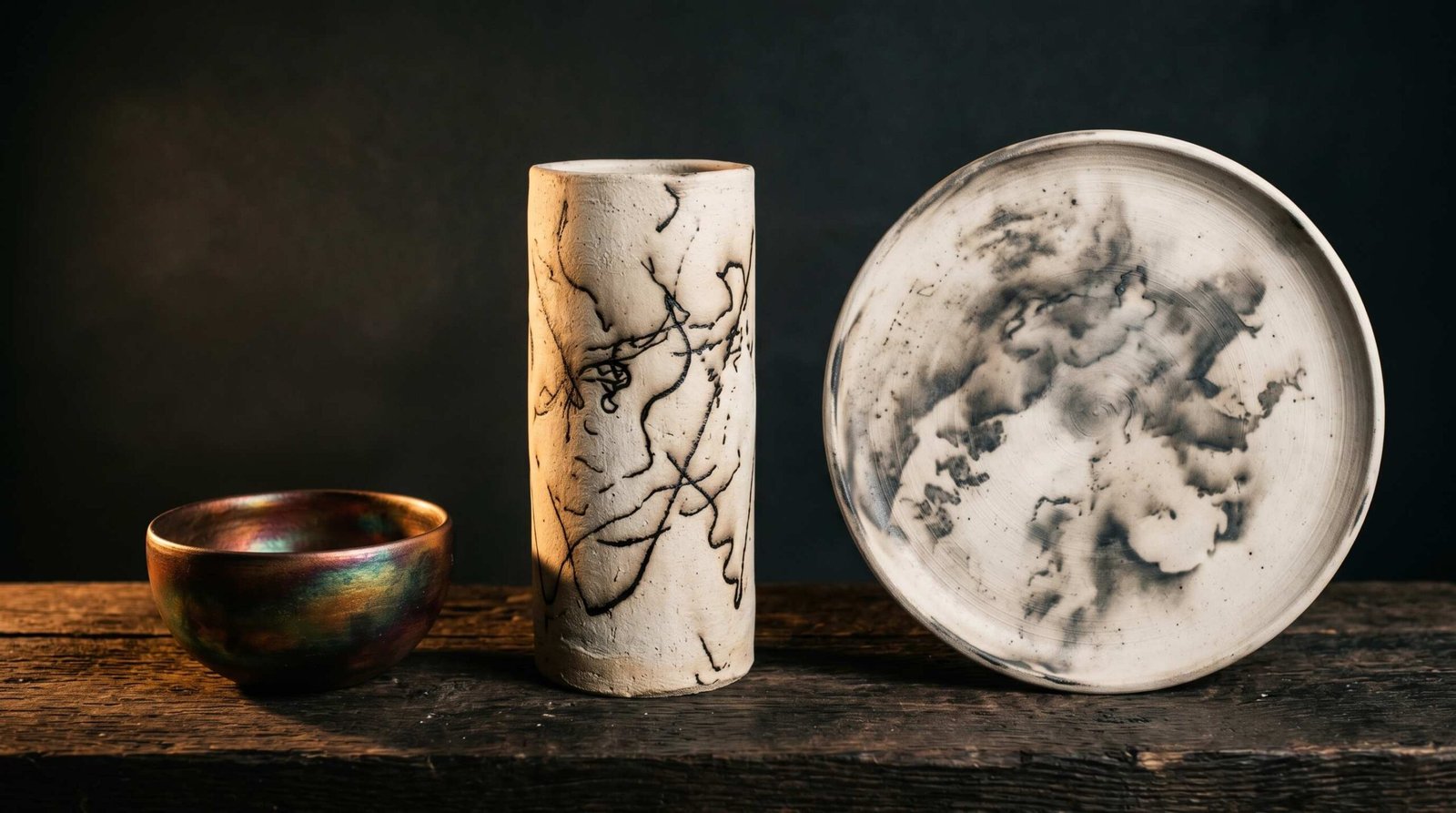
The classic Western approach and probably what most people picture when they hear “raku.” A copper-rich glaze, often containing copper carbonate or copper oxide, is fired to glaze melt then reduced heavily in the chamber. The result is a rich, matte, coppery patina that shifts between rose, green, and bronze depending on how thoroughly the piece was reduced. The surface has the look of weathered metal, not glass.
Horse Hair Raku
One of the most striking variations. The pot is fired bisque-style with no glaze at all, then heated in the kiln to roughly 732°C (1350°F). The potter pulls the hot piece out and immediately drapes individual horsehairs (or feathers, or strands of plant material like dried grass) across the surface. The hair burns away in a fraction of a second, leaving a black carbon line burned permanently into the bare clay where it touched.
The patterns look like wild brushstrokes laid down by a hand you can’t see. Some potters apply the hair in deliberate designs; others throw it on randomly and let chance do the work. No reduction chamber is needed because the carbon transfer happens on contact with the open hot surface.
Naked Raku
So called because the finished pot ends up bare, with no glaze remaining on the visible surface. The technique works in layers: the potter applies a thick slip (clay slurry) over the entire pot, then a glaze over the slip, then fires the piece. During reduction the slip resists the glaze and absorbs the smoke. When the pot has cooled, the glaze and slip layer peels (or is scraped) away entirely, revealing a bare clay surface marked with the smoke patterns that worked their way through the gaps in the slip.
The result is highly textural: crackled, earthy, monochromatic, and unmistakably its own thing. Naked raku has become one of the most influential post-Soldner innovations in the Western tradition.
Obvara
An older Baltic and Eastern European tradition that predates contact with Japanese raku entirely but uses the same hot-pot principle. The red-hot bisque-fired piece is plunged into a fermented slurry of yeast, flour, water, and sometimes sugar. The slurry ignites and boils on contact with the pot, baking onto the surface in an instant. The result is a deeply organic, bubbly, marbled texture that ranges from pale beige to nearly black depending on the recipe and dip time.
Obvara has been practiced for centuries in places like Belarus, Latvia, and parts of Russia. Western raku potters have adopted it as a sibling technique, often firing obvara pieces in the same outdoor session as standard raku work.
What Clay Body Do You Need for Raku?
Standard pottery clay will not survive raku. The temperature change from 1000°C kiln to a metal can full of cool combustibles is a thermal shock of nearly the full firing range, and ordinary stoneware bodies will crack, crumble, or shatter when treated this way. Choosing the right clay is the single most important material decision you’ll make.
Look for clay bodies specifically labeled “raku” or “raku blend.” These are formulated with high levels of grog (pre-fired ground clay, usually 15-20% by weight), kyanite, or coarse silica sand mixed into a base clay. The added particles open up the clay structure, leaving microscopic gaps that let the body flex slightly as it cools instead of cracking. They also give raku ware its characteristic gritty texture.
Firing range matters too. Raku clay bodies are designed to mature at cone 06 (around 1000°C / 1830°F), which is well below stoneware temperature. Firing them higher will warp or melt the body. For a full breakdown of clay options including porcelain, earthenware, stoneware, and raku, see our guide to the types of pottery clay and their uses.
Equipment You Need to Try Raku
The equipment list for raku is shorter than it looks. You don’t need a dedicated raku studio, just a safe outdoor space, a kiln that can reach cone 06, and a few specific safety tools. Here’s what we suggest as the minimum kit.
| Equipment | What It’s For | Approximate Cost |
|---|---|---|
| Small electric or propane kiln | Firing to 1000°C | $400-$2,000 |
| Long steel tongs (18-24 inch) | Safely removing red-hot pottery | $30-$80 |
| Reduction container (metal garbage can with lid) | The reduction chamber | $25-$50 |
| Combustibles (newspaper, straw, sawdust) | Fuel for reduction | Free or cheap |
| Heat-resistant gloves | Hand protection from burns | $20-$60 |
| Face shield or safety goggles | Eye protection | $15-$40 |
| Bucket of water | Emergency quench | Free |
Many potters first try raku at a pottery studio or community workshop rather than investing in their own kiln. That’s almost always the right starting move, both for safety and for cost. If you’re ready to set up your own space, our pottery studio at home guide covers what you’ll need. For kiln selection specifically, see our pottery kilns for beginners guide.
Raku Safety, What You Cannot Ignore
Raku is one of the most rewarding ceramic techniques and one of the most genuinely dangerous. The combination of open flame, red-hot ceramic, smoke, fumes, and toxic glaze materials puts it in a different risk category from almost any other pottery practice. We suggest reading this section twice before attempting a firing.
Carbon monoxide risk. Reduction works by burning combustibles in an oxygen-starved environment, and incomplete combustion produces carbon monoxide gas. CO is colorless, odorless, and lethal at moderate concentrations. Always fire raku outdoors or in a space with serious mechanical ventilation. Never raku in an enclosed garage, basement, or shed, even with a window open.
Burns. The pottery comes out of the kiln at 900-1000°C, hot enough to set wood on fire on contact. Long tongs (at least 18 inches, preferably 24) are mandatory. Heavy leather or aluminized gloves rated for kiln work are required, not optional. Keep bystanders at least 10 feet back from the kiln-to-can pathway and never let anyone untrained handle the tongs. Burns from raku pottery are slow-healing and serious.
Kiln fumes. Some raku glazes (especially traditional Japanese lead-based formulations and some heavy copper formulations) produce toxic fumes during firing. Modern commercial raku glazes are formulated to be much lower in toxicity, but you should still fire with strong ventilation and avoid leaning over the kiln peephole when checking glaze melt.
Silica dust. Crystalline silica dust is produced whenever dry clay is sanded, swept, or mixed. Per OSHA’s crystalline silica standards, prolonged inhalation causes silicosis, a serious and irreversible lung disease. Always wet-mix clay where possible, wet-mop your studio floor instead of sweeping, and wear a properly rated N95 or better dust mask when dry-mixing materials or sanding bisque ware.
Thermal shock explosions. If your clay body isn’t correctly formulated for raku (insufficient grog, kyanite, or sand), the piece can shatter violently when transferred from kiln to reduction chamber. Shards travel fast. Wear a face shield, not just safety goggles, and assume that any unfamiliar clay body might fail until you’ve successfully fired several pieces from the same batch.
Fire risk. The combustibles in the reduction chamber catch fire aggressively, sometimes flaring two or three feet above the can when the lid first goes on. Keep a bucket of water and a fire extinguisher within arm’s reach. Never fire raku on a windy day, near dry grass or wooden structures, or under overhanging trees. A small clear patch of concrete or bare dirt is the right surface.
Can You Do Raku at Home?
Yes, with the right setup. Home raku is genuinely accessible if you have outdoor space and the budget for a small kiln, and many serious raku artists work from their own backyards.
You need outdoor space at minimum: a driveway, a backyard, a patio with no overhead obstructions. Indoor raku is not a viable option, regardless of how good your ventilation system is. The CO and combustible smoke loads are too high for any residential exhaust setup.
For the kiln itself, most home raku potters use a small propane-fired kiln rather than electric. Propane kilns are portable (you can wheel them outdoors only when firing), heat fast, and reach raku temperature easily. Small electric kilns also work if you have an outdoor covered space or a garage with the door fully open, but they’re less common in dedicated raku setups.
Your local pottery studio is almost certainly the right first step. Many community studios run dedicated raku workshops once or twice a year where you can try the whole process under supervision with shared equipment. We suggest taking at least one workshop before you spend money on home gear.
Total cost to get started at home runs $500 to $2,500 for a kiln plus equipment, depending on what you already own and whether you buy new or used. For the full breakdown of setting up your space, see our guide to setting up a home pottery studio.
Frequently Asked Questions
Q: Is raku pottery food safe?
A: No. Raku pottery is NOT food safe. The low firing temperature (cone 06, around 1000°C) leaves the clay body porous and partially vitrified. Raku glazes often craze or crack, allowing liquids and bacteria to penetrate the clay. Traditional Japanese raku tea bowls were used for ceremonial tea only, never for food storage or acidic beverages.
Q: What temperature does raku fire at?
A: Raku fires at approximately 900-1,000°C (1,652-1,832°F), or cone 06 on the ceramic cone scale. This is much lower than high-fire stoneware (cone 10, ~1,280°C) or even mid-fire pottery (cone 6, ~1,220°C). The low temperature is part of why raku is faster to fire and why pieces are not food safe, as the clay doesn’t fully vitrify.
Q: Do you need a special kiln for raku?
A: You don’t need a dedicated raku kiln, but most potters prefer a small propane-fired kiln for outdoor use. Many small electric kilns can also fire to cone 06. What matters most is that you can access the pottery with tongs while it’s still glowing, so kilns with wide-opening lids work best. Front-loading kilns require extra safety planning.
Q: How long does raku firing take?
A: The glaze firing itself typically takes 20-45 minutes once the kiln reaches temperature, which is dramatically faster than high-fire pottery (8-12 hours). Add 10-15 minutes in the reduction chamber plus cooling time, and a complete raku firing can be done in under two hours from cold kiln to finished piece.
Q: What is the difference between raku and regular pottery?
A: Regular pottery is fired slowly to full temperature, left to cool in the kiln over many hours, and produces food-safe, durable results. Raku pottery is fired faster, removed from the kiln while red-hot, and subjected to thermal shock and smoke reduction. The result is decorative, not food safe, and every piece is entirely unique, as no two raku pieces ever look exactly alike.
Q: Can beginners do raku?
A: Yes, but beginners should start at a pottery studio or workshop rather than alone. The process involves extreme heat, fire, and thermal shock, and understanding the safety rules before attempting raku at home is essential. Many community pottery studios run dedicated raku firing days where you can try the process under supervision before investing in your own equipment.