

Selling Pottery on Etsy: The Complete Guide to Your First Sale and Beyond
To sell pottery on Etsy, open a free shop account, photograph your pieces against a clean background, price each item to cover materials plus at least 2 hours of labor plus a 20-30% profit margin, and list using relevant keywords like “handmade ceramic mug” in your title. Use all 13 tags per listing, write descriptions that lead with your best selling point, and double-box every shipment to prevent breakage.
Is Etsy Worth It for Pottery Sellers?
Short answer: yes, with caveats. Etsy is the most efficient way for a new pottery seller to reach buyers actively searching for handmade ceramics. The platform serves over 90 million active buyers, and those people arrive ready to spend on craft. You do not have to build that traffic yourself, which is the single biggest advantage for a hobbyist potter making 5 to 20 pieces a month.
The honest downside is the fee structure. Between transaction fees, payment processing, and listing costs, you will hand back roughly 10 to 12 percent of every sale to Etsy. For pottery, where labor already eats most of your margin, that bite stings. Saturation is also real. Search “ceramic mug” and you will see thousands of listings, many priced below what it costs to actually make a mug.
You may have read the ceramic.school argument against Etsy, and parts of it are fair. Established potters with a customer base and brand recognition often do better selling direct. But that argument skips the question every beginner faces: where do those first customers come from? Etsy is a launchpad, not a ceiling. It is the place to test what sells, what prices buyers accept, and what photography style converts, before you graduate to your own site or local markets.
If you are still weighing whether pottery itself is a viable side income, our broader piece on selling pottery online covers the full landscape beyond Etsy alone.
What Pottery Sells Best on Etsy
Not every type of pottery sells equally. Some categories are crowded with thousands of competing listings, while others have steady demand and far less competition. Knowing which is which shapes what you should make first.
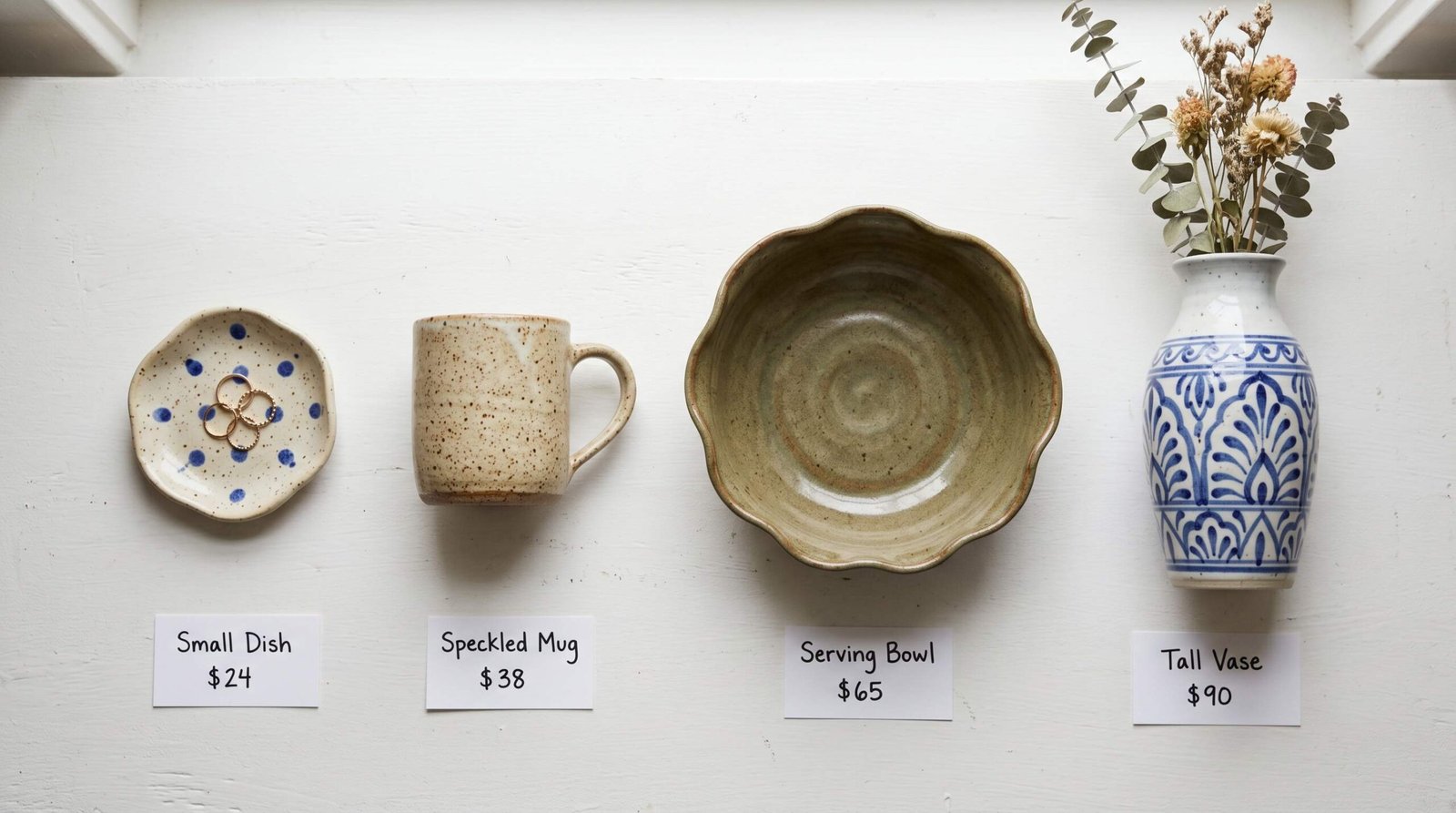
| Item Type | Typical Price Range | Competition Level | Notes |
|---|---|---|---|
| Mugs | $25-$65 | HIGH | Largest buyer pool, also the most listings to beat |
| Bowls | $35-$85 | MEDIUM | Cereal, ramen, and serving sizes all sell well |
| Planters and pots | $20-$55 | MEDIUM | Houseplant boom keeps demand steady |
| Vases | $30-$80 | MEDIUM | Bud vases under $40 move fastest |
| Decorative plates | $40-$120 | LOW | Wall-hanging and display pieces, less crowded |
| Custom or personalized pieces | $45-$150 | LOW-MEDIUM | Highest margins, repeat buyers, wedding gifts |
| Jewelry dishes | $20-$45 | MEDIUM-HIGH | Low cost to make, popular gift item |
The pattern is clear once you look at the table. Custom and personalized pieces command the highest margins because the buyer is not comparing your $90 monogrammed wedding bowl to fifteen others, while mugs and jewelry dishes face brutal price competition. If you can offer a personalization option, even something as simple as adding initials, you immediately step out of the price-war category.
Color and style matter too. Speckled neutrals, organic shapes, and matte finishes have outperformed glossy bright glazes on Etsy for the past several years. If you are still developing your aesthetic, our piece on glazing your pottery walks through finishes that photograph well and command higher prices.
Pricing Pottery for Etsy: The Formula That Actually Works
The single biggest mistake new sellers make is pricing based on what other shops charge. Those shops may be losing money. They may be hobbyists who do not count their time. They may be liquidating inventory. You cannot price your work based on theirs without knowing their cost structure.
Use this formula instead:
- Materials cost: clay, glaze, kiln firing cost per piece
- Labor: time multiplied by your hourly rate, with $15 to $25 per hour as a floor
- Overhead: studio rent, equipment depreciation, water, electricity not already in firing cost
- Etsy fees: approximately 10 to 12 percent of sale price plus the $0.20 listing fee
- Profit margin: 20 to 30 percent on top of all of the above
Here is a worked example for a ceramic mug priced at $45:
- Clay: $1.50
- Glaze: $0.80
- Kiln firing (prorated across the load): $2.00
- Labor: 1.5 hours at $20 per hour = $30.00
- Overhead: $2.00
- Subtotal cost: $36.30
- Etsy fees on a $45 sale: approximately $5.10 (6.5 percent transaction fee, payment processing, prorated listing fee)
- Net received: roughly $39.90 on a $45 sale
- Profit margin: about 25 percent over true cost
If your math returns a profit margin under 20 percent, raise the price or reduce labor time. Underpricing is not a marketing strategy. It is a slow way to burn yourself out and quit. Buyers on Etsy who pay $45 for a handmade mug are not looking for the cheapest option. They are looking for the one they want to drink coffee from every morning.
Tracking your actual labor matters. Time yourself across an entire batch from wedging to final glazing, divide by the number of finished pieces, and use that real number. Most new potters under-count by 30 to 50 percent. The investment in how much pottery equipment costs also deserves a line in your overhead calculation, prorated across the lifetime of each piece of gear.
How to Photograph Pottery for Etsy
Photography is where most pottery shops on Etsy lose sales they should have won. Buyers cannot pick up your mug. They cannot feel the weight of the clay or see how light hits the glaze. Your photos have to do that work, and most shops settle for one flat shot on a cluttered table.
Here is what actually works:
Lighting: natural side lighting from a north-facing window beats almost any other setup. No direct sun, which blows out highlights on glossy glazes. If your window light is weak or inconsistent, a $40 lightbox solves the problem. Avoid mixing daylight with overhead room lights, which throws color balance off and makes your glaze colors look wrong.
Background: plain white, unbleached linen, or a slate tile. Nothing more. Busy backgrounds compete with the pottery and confuse the buyer’s eye. A roll of white seamless paper from an art supply store costs about $15 and lasts months.
Angles: shoot at least five images per listing. Etsy allows ten, and you should use all ten when you can. The essentials are: front straight-on, three-quarter angle, interior shot for mugs and bowls, the bottom if you have a signed mark or interesting glaze drip, and a side profile.
Scale: buyers misjudge size constantly. Include one shot with a hand holding the piece, or a coin or ruler nearby. This single addition cuts return rates significantly.
Action shot: coffee steaming in the mug, a plant in the pot, a stem in the vase. This is the photo that converts. It shows the piece in use, in a real life buyers can imagine themselves living.
Edit lightly. Brighten exposure if needed, correct white balance, crop tight. Do not over-saturate colors, because buyers who receive a duller piece than the photo will return it and leave a one-star review citing color difference.
Writing Etsy Listings That Rank and Convert
Etsy search is keyword driven. Your title and tags determine whether buyers see your listing at all, and your photos and description determine whether they buy.
Title structure: lead with what the item is, then material or style, then size or color, with “handmade” worked in naturally. Etsy reads the first 40 characters most heavily, so front-load your most important keywords.
Example: “Handmade Ceramic Mug | Stoneware Coffee Mug | 12oz | Speckled Blue”
That title hits “ceramic mug,” “stoneware,” “coffee mug,” “12oz,” and “speckled blue” all in one line, which means it can show up for any combination of those searches.
Tags: use all 13. Not 10, not 11. Thirteen. Research what real buyers search by typing your item type into the Etsy search bar and reading the autocomplete suggestions. Those are real searches. Use them. Vary single words and multi-word phrases, because Etsy treats them differently in ranking.
Description: lead with the most important selling point in the first two lines. Etsy truncates the description in search previews, and many buyers never expand it. Then cover the specifics: clay type, glaze, food-safe status, dishwasher and microwave safety, dimensions, weight, and any care instructions.
Mentioning food safety is not optional for mugs and bowls. Buyers ask, and if the answer is not in the description, they often skip the listing entirely. If you fire to cone 6 with a tested food-safe glaze, say so plainly.
For inspiration on the production side that supports better listings, our breakdown of the basic pottery tools covers the gear that helps you maintain consistency across pieces, which buyers notice in repeat orders.
Etsy Fees: What You Actually Pay
Etsy publishes its fee structure clearly, but the way fees stack on a single sale catches new sellers off guard. Here is the full picture.
| Fee Type | Amount | When Charged |
|---|---|---|
| Listing fee | $0.20 per item | When you list or relist (every 4 months or after sale) |
| Transaction fee | 6.5% of sale (includes shipping price) | On each sale |
| Payment processing (US) | 3% + $0.25 | On each sale |
| Offsite Ads fee | 12-15% | Only when a sale comes from an Etsy-paid ad |
| Etsy Plus | $10 per month | Optional subscription |
Realistic example using a $45 mug sale with $8 shipping:
- Listing fee: $0.20
- Transaction fee on $53 (item plus shipping): $3.45
- Payment processing: $1.84
- Total fees: $5.49
- You keep: $47.51 of the $53 collected (about 89.6 percent)
One critical note on Offsite Ads. Etsy advertises your listings on Google, Facebook, and other platforms. If you make over $10,000 per year on Etsy, this is mandatory and the fee is 12 percent. Under that threshold, you can opt out, and we suggest you do until you understand which of your listings convert well enough to pay for the ad cost.
You can open your Etsy shop for free, and you only pay listing fees when you actually list items. There is no monthly minimum, which makes it a low-risk starting point.
Shipping Pottery Without Breakage
Nothing kills a new pottery shop faster than a string of broken-on-arrival reviews. Pottery is fragile, shipping carriers are rough, and shipping insurance does not undo a one-star review. Your packaging has to assume the box will be dropped from waist height at least twice.
The double-box method is the gold standard. Wrap the piece in two layers of bubble wrap, place it in a small inner box surrounded by packing paper or foam peanuts so it cannot shift, then put that entire box inside a larger outer box with another two inches of cushioning on all sides. This sounds excessive. It is not. It is what works.
A few specific tips:
- Stuff hollow forms (mugs, vases, bowls) with packing paper so the walls do not flex under pressure
- Mark “Fragile” on the outside of the outer box on all four sides, this actually does change handling at major carriers
- Weigh your fully packaged piece before listing, then enter the real shipping price in Etsy’s calculator
- For items over $50, add insurance, the cost is small and saves arguments later
- Ship same-day or next-day when possible, fast shipping shows up in your reviews and shop stats
Buyers in cold climates sometimes report pieces arriving cracked from temperature shock in winter months. If you ship to a cold region in December or January, a note in your listing that recommends letting the package warm to room temperature before unboxing prevents some of these claims.
Etsy vs. Selling Pottery Elsewhere: A Comparison
Etsy is one option. It is not the only option. Knowing the alternatives helps you decide where to invest your time, and many successful potters end up using two or three channels at once.
| Platform | Setup Cost | Traffic | Fees | Best For |
|---|---|---|---|---|
| Etsy | Free | Built-in marketplace | ~10-12% per sale | New sellers, hobbyists, testing the market |
| Your own website | $10-30 per month | Build from scratch | Payment processor only (~3%) | Established sellers with repeat customers |
| Local markets/craft fairs | $30-100 booth fee | Event attendees | None (or payment processor) | High-end pieces, larger forms, local community |
| Instagram/social | Free | Algorithm-dependent | ~3% (via links out) | Brand building, driving traffic to Etsy or your site |
Most potters who treat this as a side income use Etsy plus one other channel. Local craft fairs work especially well for larger pieces that are expensive to ship safely. Our guide to what pottery sells best at craft markets covers the in-person side in detail, including how booth setup and price points differ from online.
Instagram is rarely a sales platform on its own, but it is the best free tool for building a brand voice and an audience that returns to buy from your Etsy or website later. Post your process, not just finished pieces.
Frequently Asked Questions
How much does it cost to start an Etsy pottery shop?
Opening the shop itself is free. Your first listing costs $0.20, and that listing stays active for four months or until it sells. If you list 20 starting pieces, you are looking at $4.00 in listing fees plus whatever you have already invested in clay, glazes, and kiln access. There is no monthly fee, no setup fee, and no minimum sales requirement. The realistic startup cost for a hobbyist with existing pottery equipment is under $20.
How long does it take to get your first sale on Etsy?
Most new pottery shops see their first sale within 2 to 8 weeks of listing 15 or more well-photographed items. Shops that list only 3 or 4 pieces and stop often wait months. The Etsy algorithm rewards active shops, so consistent listing and renewing keeps you visible. Your first sale is partly skill and partly luck, but skill compounds and luck does not.
Do I need a business license to sell pottery on Etsy?
It depends on your state and city. Some jurisdictions require any seller to register, while others have a hobby income threshold below which no license is needed. Check with your state revenue department first. If you are scaling beyond hobbyist income, you can register your business with the SBA and your state to formalize the operation.
Is handmade pottery considered a hobby or a business for tax purposes?
The IRS distinguishes between hobby income and business income based on profit motive, regularity of activity, time invested, and whether you depend on the income. If you sell occasionally and do not aim for profit, it is a hobby. If you actively try to grow sales and reinvest, it is a business. Business status lets you deduct expenses, but it also requires self-employment tax filing. Review the IRS self-employment tax guidance for the current rules, and consider talking to a tax professional if you cross $400 in net annual income.
How many pottery items should I list when starting out?
Aim for at least 15 to 20 listings before you expect meaningful traffic. Etsy’s algorithm favors shops with depth, and buyers who land on a shop with only 3 items rarely come back. If you cannot produce 20 finished pieces yet, list multiple sizes, color variations, or sets of the same form to round out your shop. Quality matters more than quantity, but quantity is the entry ticket.
Can I sell pottery from a home studio on Etsy?
Yes, and most pottery sellers on Etsy do exactly that. Etsy does not inspect your studio or require commercial space. The practical limits are local zoning rules and homeowner association policies on home-based businesses, plus electrical capacity for a kiln. A standard 240V kiln line installed by an electrician costs $400 to $900 and is the most common home-studio upgrade.
What are the most common mistakes new pottery sellers make on Etsy?
The five most common mistakes are: underpricing to compete with established shops, using only one or two photos per listing, leaving tags blank or using only a few, packaging inadequately and shipping broken pieces, and listing only a handful of items then stopping. Each of these is fixable in an afternoon, but the cost of leaving any one of them in place is months of slow sales.