
You finished a kiln load. The mugs came out clean, the bowls are even, and friends keep telling you they would buy your work. So how do you actually do it? Selling pottery online sounds like the easy answer, until you start asking what platform to use, what to charge, what shipping a fragile ceramic piece actually costs, and how to get someone to find you in the first place.
This is a US-focused guide written for potters who can make the work and now want to sell it. The short answer: pick the platform that matches where you are right now (Etsy if you are starting out, your own Shopify or Squarespace site once you have a brand, Faire for wholesale, Instagram for direct sales), price at 2.5 to 3x your materials and time, budget $15 to $25 per shipped box for fragile packaging, and expect 30 to 90 days to your first sale. The longer answer is the rest of this guide.
The Quick Answer for Skim Readers
To sell pottery online in 2026: open an Etsy shop for the easiest start (real cost: 20 cents per listing plus 6.5% transaction fee plus 3% + 25 cents payment processing on US sales). Photograph each piece in soft natural light, three shots minimum (product, scale, lifestyle). Price at 2.5 to 3x your materials and labor cost. Budget $15 to $25 per shipped order for packaging plus postage, since pottery is heavy and fragile. Market on Instagram with three to four posts per week and an email list from day one. Expect your first sale within 30 to 90 days if you market actively.
Where to Sell Pottery Online: The Platform Breakdown
Every platform makes different tradeoffs between ease of setup, audience size, fee structure, and brand control. Pick based on where you are in your pottery journey, not where you want to be in five years.
Etsy: Best for Beginners
Etsy remains the default first stop for handmade sellers because the platform already has buyers actively searching for pottery. You do not need a brand, a following, or a website. You list a piece, write a description, and Etsy puts it in front of people who type “ceramic mug” or “handmade pottery” into the search bar.
The fee structure is straightforward but adds up. Per Etsy’s how-selling-works page, US sellers pay a 20 cent listing fee (the listing stays active for 4 months or until it sells), a 6.5% transaction fee on the total order including shipping, and a 3% + 25 cent payment processing fee through Etsy Payments. If you opt into Offsite Ads (or are required to because of sales volume), Etsy adds a 15% fee on any sale that came from those ads. Etsy’s payment processing fee table breaks out the per-country rates.
On a $50 mug with $8 shipping, that math looks like: 20 cent listing + (6.5% × $58 = $3.77 transaction) + (3% × $58 + 25 cents = $1.99 payment processing) = $5.96 in fees, leaving you with $52.04. That is before postage and packaging, which we will get to.
Pros: Easiest setup. Built-in buyer traffic. No monthly fee. Native discoverability through search.
Cons: Total fees roughly 10-13% of order value once you include payment processing. Discoverability is increasingly pay-to-play through Etsy Ads. Brand differentiation is hard since every listing looks similar.
Use Etsy if: You have fewer than 30 pieces ready to sell, no audience, and you want to test whether your work sells before investing in a brand site.
Your Own Site (Shopify or Squarespace): Best for Established Makers
Once you have a brand, repeat buyers, and a few hundred dollars per month coming in through Etsy, the math starts favoring your own site. You trade higher monthly costs for full brand control, lower per-transaction fees, and the ability to build a real email list of customers (something Etsy actively discourages).
Shopify is the dominant pick for established handmade sellers. Per Shopify’s pricing page, the Basic plan runs $39 per month, the Grow plan $105, and Advanced $399, with annual billing offering a discount. If you use Shopify Payments (the recommended option), credit card rates fall between 2.4% and 3.5% depending on plan, with no separate transaction fee. If you use a third-party payment processor, Shopify adds 0.5% to 2% on top of the processor’s own fee, which usually erases the savings.
Squarespace is the strong alternative if you care more about visual design than backend customization. Their Business plan at $23 per month or Commerce plans at $27-49 cover most pottery seller needs, with the Commerce Advanced plan eliminating per-sale fees.
Pros: Full brand control. Lower variable fees on volume. Direct email list ownership. Unlimited custom pages, blog posts, and product photography. Easier to build a returning customer base.
Cons: You bring the traffic. No built-in audience like Etsy provides. Monthly cost continues whether you sell or not. Real setup time of 20-60 hours to look professional.
Use your own site if: You have an email list of 200+ or an Instagram following of 1,000+, and you are tired of Etsy’s ad fees and brand limitations.
Faire: Best for Wholesale
If retailers (independent boutiques, gift shops, cafes) want to carry your work, Faire is the dominant wholesale marketplace for makers in 2026. Per Faire’s North America pricing page, joining is free with no monthly cost. You pay 15% commission on orders that come through the Faire marketplace, plus a one-time $10 new-customer fee on the first order from each new retailer. Payment processing fees vary by payout speed: 3.5% + 30 cents for next-day payout, 2.4% + 30 cents for 30-day, or 1.9% + 30 cents for 60-day.
Faire’s killer feature for makers is Faire Direct: when you bring your own retailer customers to the platform via your personalized link, those orders process at 0% commission. Use Faire as your wholesale ordering infrastructure (orders, invoicing, net-60 terms for buyers) without losing the 15% on customers you already have.
Pros: Designed for wholesale specifically. Net-60 terms make buying easier for small retailers. Free returns on first orders reduce buyer risk. Faire Direct lets you keep your own customer relationships at 0% commission.
Cons: Wholesale pricing is typically 50% of retail, which only works if your unit economics support it. 15% commission on marketplace orders is significant on already-discounted wholesale pricing.
Use Faire if: You can produce 20+ pieces per month consistently, retailers have shown interest at craft fairs, and your unit cost lets you sell wholesale (your retail price minus 50% minus 15% commission still covers materials, labor, and overhead).
Instagram and Direct DM Sales
Instagram is not a marketplace in the Etsy or Shopify sense, but it is the dominant discovery channel for handmade pottery in 2026. Many established potters run their entire business through Instagram, with sales happening in DMs, through link-in-bio storefronts, or via Instagram Shopping where their Shopify catalog auto-syncs.
This works once you have an audience. It does not work as a starting point because building an Instagram following from zero takes months to years. Treat Instagram as the marketing layer over your actual storefront (Etsy or Shopify), not as the storefront itself.
Specialty Platforms (Big Cartel, Folksy, Patreon)
Big Cartel runs $0 to $29.99 per month depending on listing count, targeted at small-batch artists who want a simple branded shop without Shopify’s complexity. Folksy is the UK-focused equivalent of Etsy if you sell internationally. Patreon works for potters with collector audiences who pay monthly for access to first dibs on new work. These are niche picks, not defaults.
Platform Comparison at a Glance
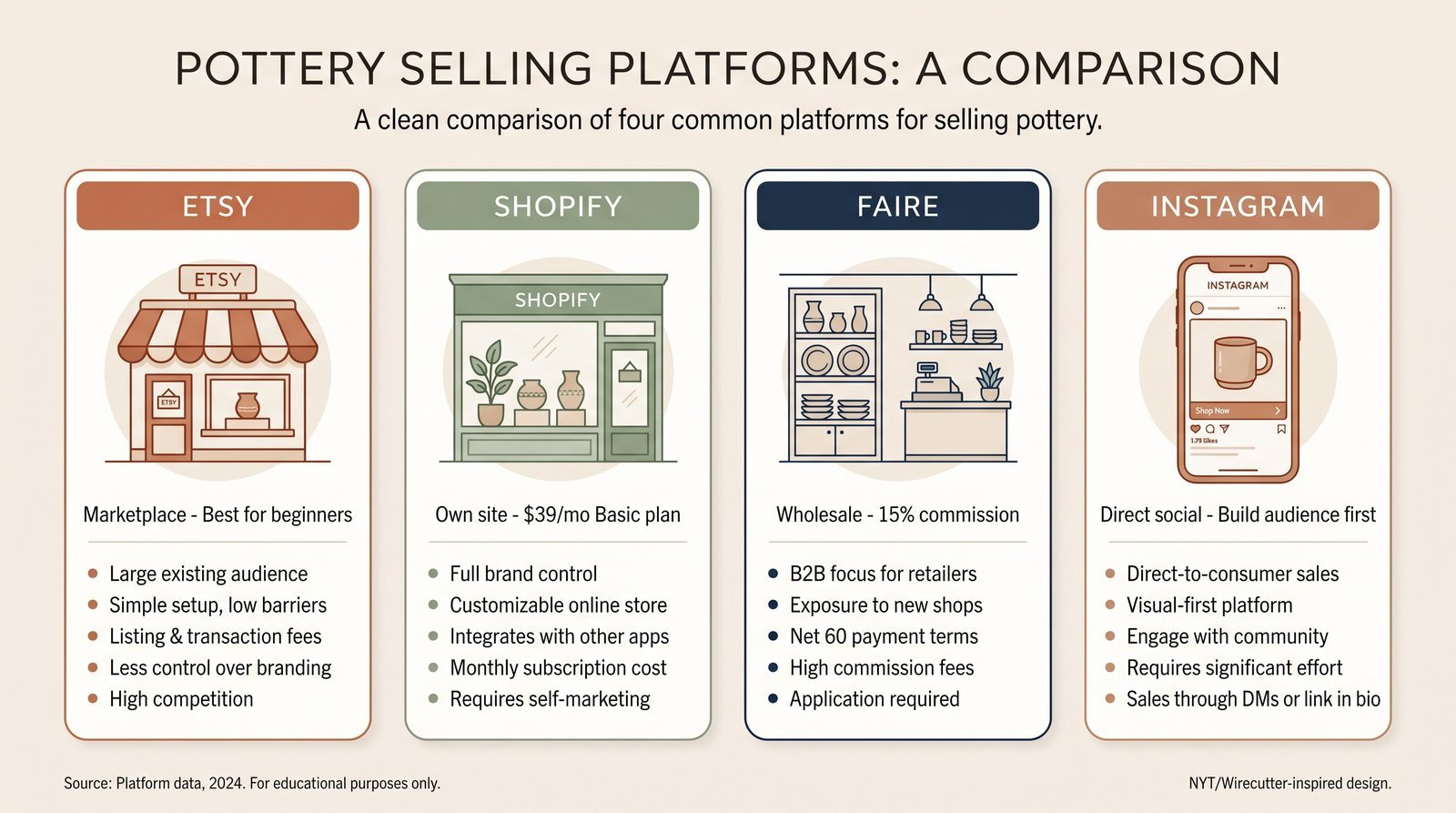
Here is the cost and fit comparison across the main platforms US potters use:
| Platform | Monthly Cost | Per-Sale Fees (US) | Audience Built In | Best For |
|---|---|---|---|---|
| Etsy | $0 | 20 cents listing + 6.5% transaction + 3% + 25 cents payment processing (~10-13% all-in) | Yes, 90M+ buyers | Beginners, first 30 pieces, testing demand |
| Shopify Basic | $39 | 2.9% + 30 cents (Shopify Payments) | No, you bring traffic | Established brand, 100+ pieces/month |
| Squarespace Commerce Basic | $27 | 2.9% + 30 cents | No | Visual brands, modest catalogs |
| Faire | $0 | 15% commission + payment processing (1.9-3.5% depending on payout speed) | Yes, wholesale retailers | Wholesale to boutiques and gift shops |
| Instagram + Linked Shop | $0 (plus shop platform cost) | 0% direct, 2.9-13% via linked shop | Yes if you have followers | Established makers with 1,000+ engaged followers |
| Big Cartel | $0-$29.99 | 0% Big Cartel fee + payment processor fee | No | Small-batch artists, under 500 listings |
How to Price Your Pottery Without Underselling
The single biggest mistake new potters make is pricing for their own perception of value rather than the market’s. You undercharge because you remember being a beginner and feel awkward asking $45 for a mug. The buyers do not care about your imposter syndrome. They care whether the piece looks like the $45 it costs.
The 2.5 to 3x Materials and Time Rule
Start with a simple formula: (cost of clay + glaze + firing) + (your time at a reasonable hourly rate) × 2.5 to 3 = your retail price.
For a mug that takes a half-pound of clay ($1.50), a thimble of glaze (50 cents), one electric kiln load fired with 20 other pieces ($1.50 per piece), and 45 minutes of your time at $25 per hour ($18.75): your cost is $22.25, and your retail price lands between $55 and $67. That feels high until you visit any craft fair and see exactly this kind of mug selling for $48 to $75 from established makers. Your work is worth its market price, not its production cost.
If you are below $40 for a thrown mug, you are losing money once you account for Etsy fees, shipping costs, and the inevitable breakage in transit.
Wholesale vs Retail: The 50% Rule
If you sell wholesale through Faire or directly to boutiques, the standard is to discount your retail price by 50%. A $60 retail mug becomes $30 wholesale, and the retailer marks it back up to $60 in their shop. Your unit economics must work at $30 minus Faire’s 15% commission ($25.50 net) minus your materials cost ($22.25) leaving roughly $3.25 per piece. Either raise your retail prices, drop your costs, or skip wholesale until you have efficiency at scale.
The Shop Update Model
Ceramic School describes a sales model worth knowing called the “shop update” model: instead of keeping inventory live constantly, you stockpile 20-50 pieces and release them all at once on a scheduled date. The scarcity, urgency, and social proof (multiple buyers competing for one-of-a-kind pieces) drive higher conversion rates than a steady-state shop. Many established potters run their entire business on monthly or quarterly shop updates. The math: 1,000 engaged Instagram followers × 3% conversion × $50 average order = $1,500 per update. Scale the follower count up and the math gets better.
Photographing Pottery for Online Sales
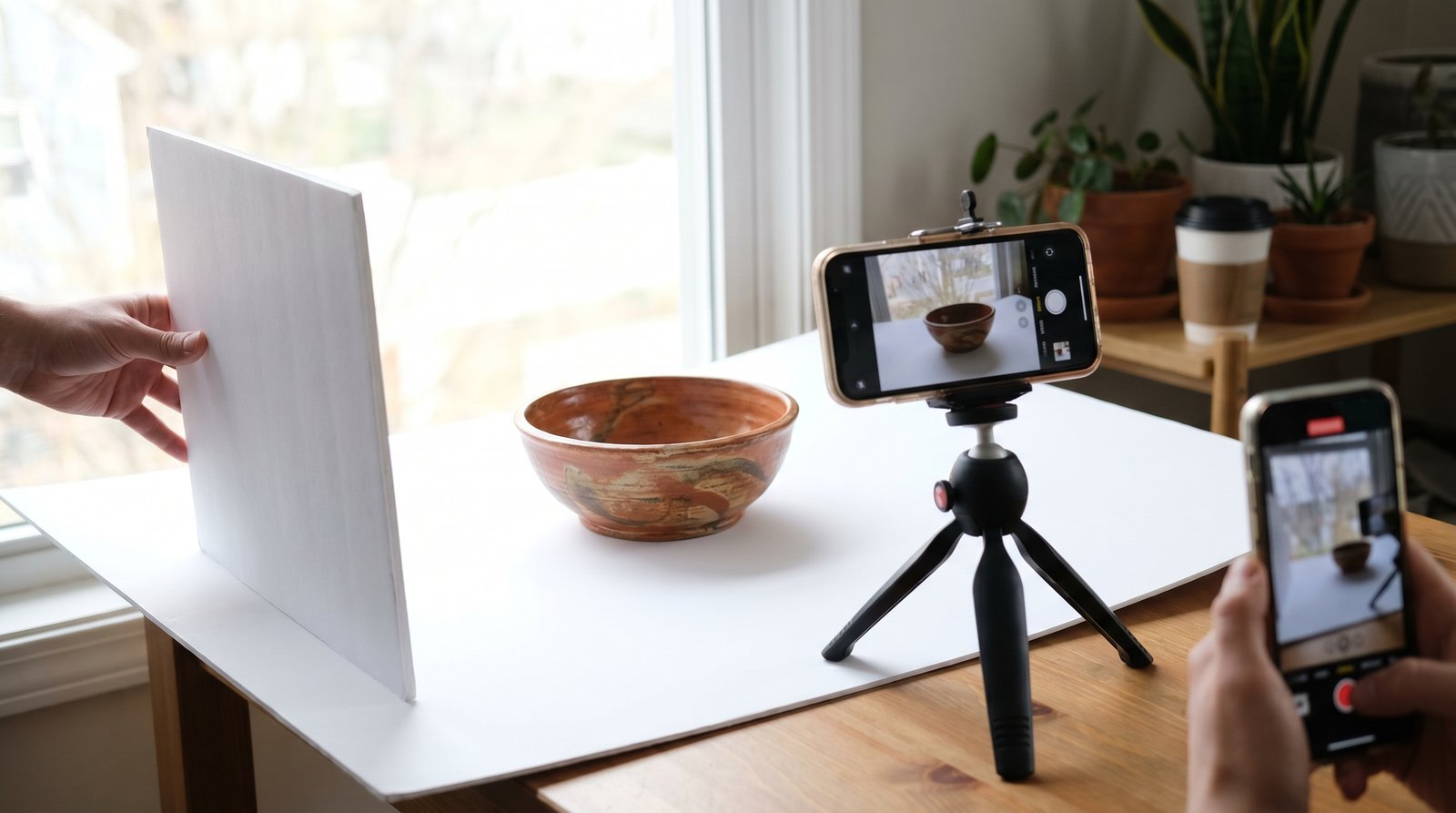
The photo is the single biggest variable in your conversion rate. A good photo will sell a $50 mug. A bad photo will fail to sell a $20 mug. You do not need a professional camera in 2026, but you do need to follow a handful of rules.
The Three-Shot Minimum
- Product shot: The piece on a clean neutral background, well-lit, in focus, multiple angles. White seamless paper, raw wood, or a soft gray fabric all work. Avoid busy backgrounds.
- Scale shot: The piece in a hand, next to a coffee can, or held by a person. Buyers cannot judge size from a product shot alone. “Looks bigger in the photo than it is” is the most common pottery returns complaint.
- Lifestyle shot: The piece being used or styled in a real setting. A mug holding actual coffee on a wooden table. A bowl with soup. A vase with flowers. This is what helps the buyer imagine the piece in their own life.
Lighting: Natural Window Light, Always
Set up next to a large window during the day. Turn off all overhead lights and any lamps in the room. Use a white piece of foam board or even a white sheet to bounce light back onto the shadow side of the piece. This gives you the soft, even, glaze-flattering light that costs nothing and takes thirty seconds to set up.
Never use direct flash. Never shoot at night with overhead lights. Both produce harsh, yellow, color-distorted images that flatten glazes and make pottery look cheap.
Phone vs Camera
A modern smartphone (iPhone 13 or newer, equivalent Android) shoots pottery as well as most entry-level cameras when used with good light. The phone wins on convenience, app integration, and quick editing. The phone loses if you need to shoot extremely close up, since wide-angle smartphone lenses distort curves at close range.
If you are not selling enough to justify $800 on a camera, your phone is fine. Spend the money on better backgrounds and a small tripod first.
Shipping Pottery: The Fragility Tax
Pottery is the worst category of goods to ship. It is heavy (driving up postage), fragile (driving up packaging cost and breakage risk), and irregularly shaped (making box-fit inefficient). New potters consistently underestimate shipping cost and either eat the difference or watch buyers abandon carts at checkout.
Real Cost Per Shipped Box
For a typical pottery order in the US (one or two pieces, total package weight 2-5 lbs):
- Box: $1.50 to $3 (don’t reuse Amazon boxes; they have weak corners after one trip)
- Bubble wrap or paper bubble wrap: $1.50 to $3
- Inner box or partition (the box-in-box method protects against drops): $1 to $2
- Packing peanuts or void fill: $0.50 to $1.50
- Tape, fragile stickers, thermal label: $0.50
- USPS Priority Mail postage (most pottery): $8 to $15 in the US, more for the West Coast or heavy pieces
All in: $15 to $25 per shipped order. Build this into your retail price OR charge actual calculated shipping at checkout. Do not offer free shipping unless you have raised your prices to absorb it. The “free shipping” Etsy boost is real, but the math has to work.
The Box-in-Box Method
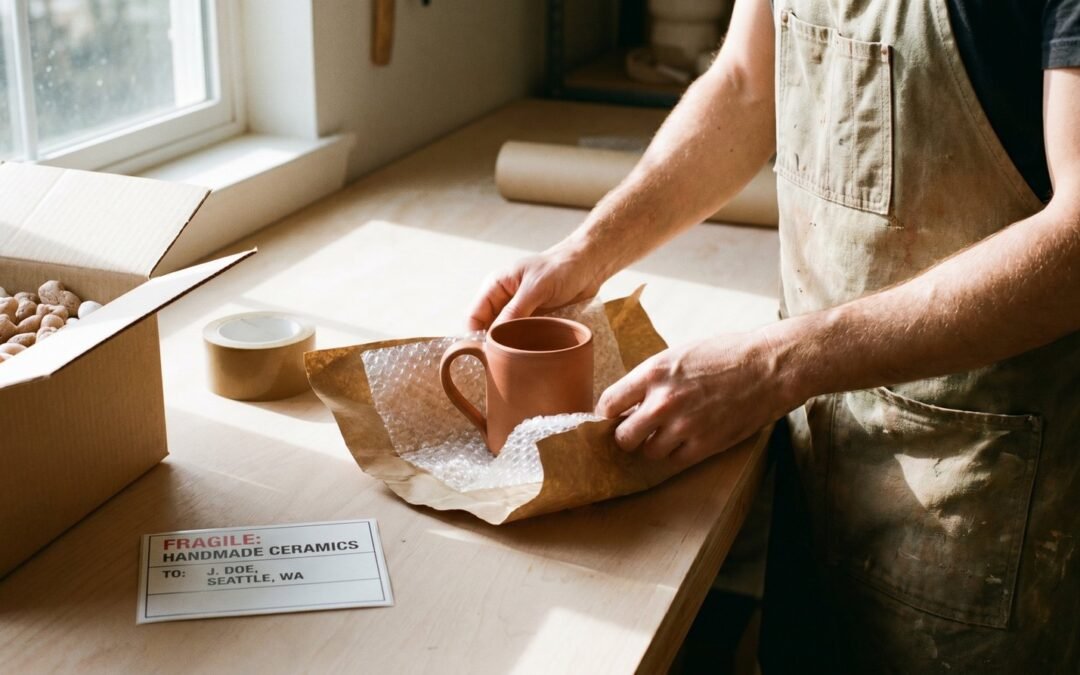
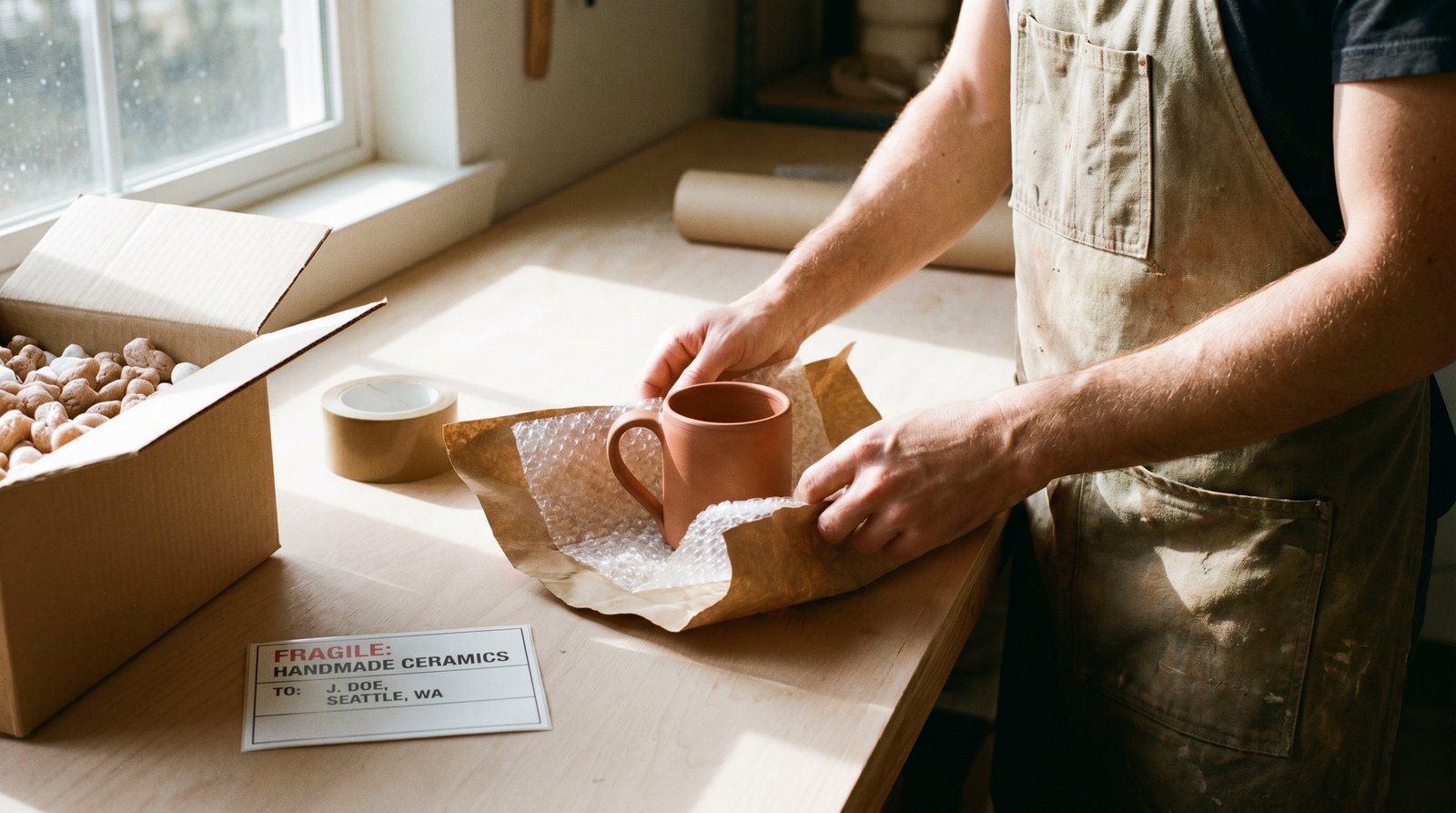
The standard protective packaging for pottery: wrap each piece in 3-4 layers of bubble wrap, place it in a smaller inner box with peanuts around it, then place that smaller box inside a larger outer box with another 2-3 inches of peanuts on all sides. The piece survives a 3-foot drop in transit, which is the realistic worst-case for USPS handling.
Carrier Choice
USPS Priority Mail is the default for most pottery shipments under 10 lbs in the continental US. UPS Ground beats USPS on cost for heavier pieces (15+ lbs) or longer distances. FedEx Ground is similar to UPS but slightly more reliable for fragile goods based on reported breakage rates in maker communities.
Always buy insurance on pottery shipments. USPS Priority Mail includes $100 insurance free; pay $2-3 extra for $250+ coverage on more expensive pieces. The insurance pays for itself the first time a USPS truck drives a box into a curb.
Marketing Your Pottery Without Becoming a Marketer
The platform is the storefront. The marketing brings the foot traffic. You can have the best pottery in the world on Etsy and sell zero pieces if nobody finds you.
Instagram: Three to Four Posts Per Week
Instagram is the dominant pottery marketing channel because pottery is visual, makers love showing process, and buyers want to feel connected to who made their mug. Post a mix:
- In-progress shots: wheel throwing, trimming, glazing, kiln loads
- Finished pieces: the same shots you use for listings
- Behind-the-scenes: your studio, your hands, the mistakes, the breakthroughs
- Reels: 15-30 second videos of wheel throwing or glazing get 5-10x the reach of static posts
Three to four posts per week, two Reels per week, and engage genuinely with other potters’ content in comments. The algorithm rewards consistency more than perfection.
Email List From Day One
Email outperforms every social platform for actual sales conversion. Engagement rates on email run 30-50% versus 3-5% on Instagram. Set up a simple email capture (Mailchimp, Buttondown, or Beehiiv all have free tiers) on your Etsy or Shopify shop. Offer a small discount or first-dibs access for signups. Email your list before every shop update with at least one preview message and one launch announcement.
Pinterest as Free Long-Tail Traffic
Pinterest is criminally underused by pottery makers. The platform behaves more like search than social: a well-tagged pin keeps driving traffic for years, not days. Pin every product photo and every blog post. Use keyword-rich descriptions. Pin to relevant boards like “Handmade Pottery,” “Ceramic Mugs,” “Kitchen Decor.” Pottery is one of the most-pinned categories on the platform, and traffic is largely free if you put in the front-loaded work of building 50-100 pins.
Craft Fairs as Discovery
Offline craft fairs remain one of the highest-converting channels for handmade pottery. Buyers can hold the piece, feel the weight, see the glaze in person. They convert at 20-30% versus 2-3% online. Collect emails at every fair. Direct buyers to your online shop after the fair for restocks. The offline-to-online flywheel is real.
The 90-Day Plan: From Zero to First Sale
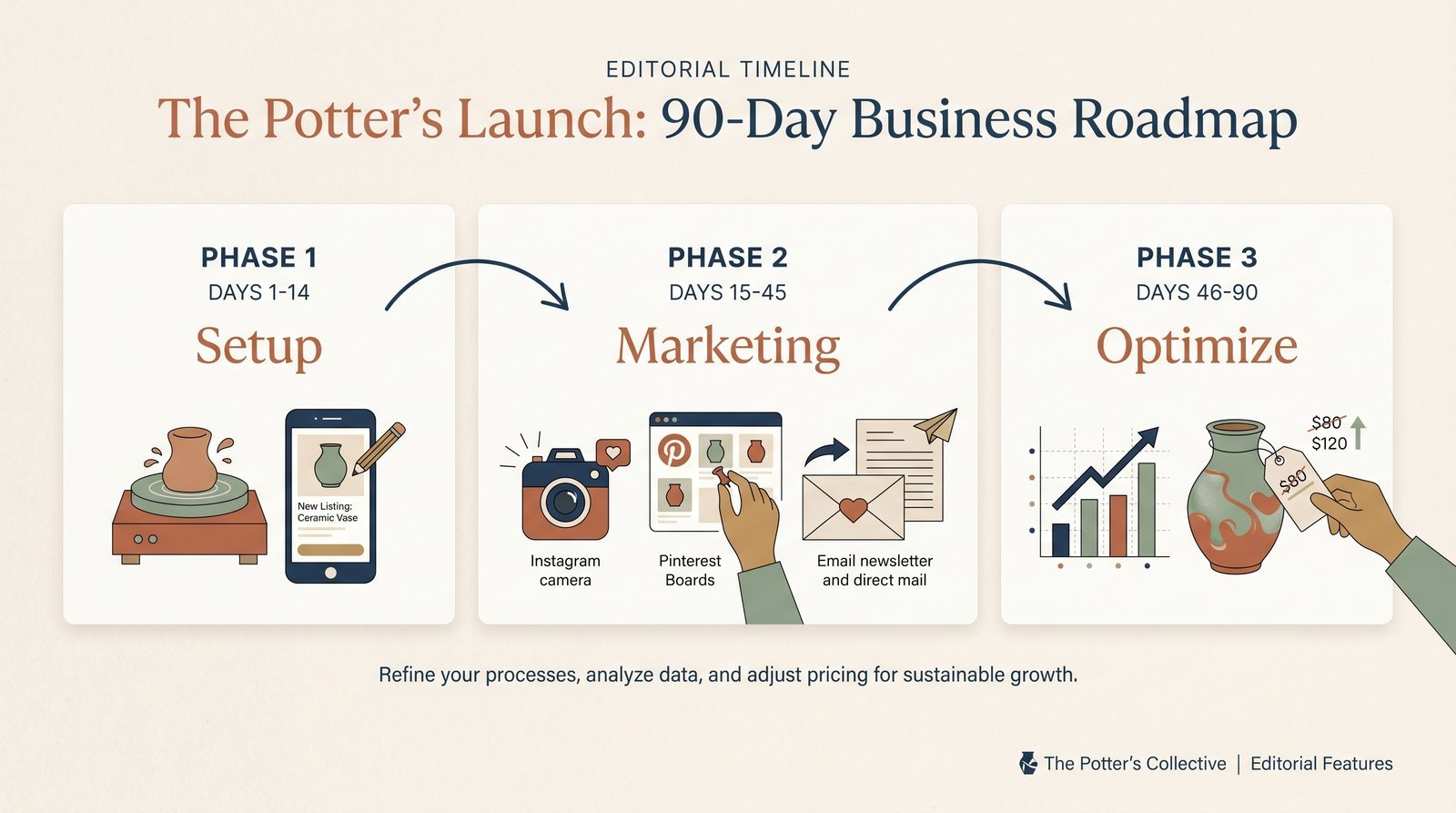
Days 1-14: Setup
- Open an Etsy seller account or Shopify Basic store
- Set up payment processing and shipping rates
- Photograph your first 8-15 pieces using the natural light method
- Write product descriptions: 2-3 sentences on the piece, dimensions, care instructions, materials
- Set prices using the 2.5-3x rule
- Create an Instagram account dedicated to your pottery
- Tell friends and family the shop is open. Get your first 5-20 followers and ask one or two to make a purchase
Days 15-45: Marketing
- Post on Instagram 3-4 times per week, mix of process and finished work
- Launch a Pinterest account, pin every product, build 30-50 pins
- Set up email capture and send your first newsletter (even to a small list)
- Engage on Instagram with 10-20 other pottery accounts per day in genuine comments
- Apply to one local craft fair (most have 30-60 day lead times)
Days 46-90: Optimize
- Review analytics: which listings get clicks, which get sales, which get ignored
- Reshoot or rewrite the worst-performing listings
- Raise prices on any piece that sold within 7 days of listing (the market is telling you it was underpriced)
- Identify your best-selling form and make more of it
- Run your first shop update if you have built 15-20 finished pieces
- Apply for additional craft fairs or local boutique consignment
Tax and Legal Basics for US Pottery Sellers
Selling pottery is a business activity even when it starts as a hobby. The tax and legal basics matter the moment you start collecting money from buyers.
Business License
Most US states do not require a business license for a sole proprietor selling under a personal name. You become “Jane Smith DBA Jane Smith Pottery” by default. If you operate under a brand name (“Little Pot Studio”), you typically need to file a DBA (doing business as) registration with your county clerk, usually $25-50. Check your state and city specifically; some cities require general business licenses for any commercial activity.
Sales Tax
After the 2018 Supreme Court decision in South Dakota v. Wayfair, online marketplaces (Etsy, Shopify) collect and remit sales tax on your behalf in most states. You usually do not need to register for or file sales tax separately for Etsy or marketplace sales. Selling directly through your own Shopify store may require you to register for sales tax permits in your home state and any state where you have “nexus” (which can be triggered by sales volume thresholds). Consult a tax professional once you cross $10,000 in annual sales.
Self-Employment Tax
Once your pottery income exceeds $400 in a year, you owe self-employment tax (15.3% on net earnings, covering Social Security and Medicare). File a Schedule C with your annual 1040. Deductible expenses include clay, glazes, kiln electricity (estimate the percentage of household electric use attributable to your kiln), studio rent if applicable, shipping supplies, and a portion of your home internet if you operate from home.
The cost of your pottery equipment itself (wheel, kiln) is depreciable over 5-7 years, but you can also elect Section 179 to deduct the full cost in the year of purchase if the equipment is used more than 50% for the business. For most committed potters, this is the better option. If you are still calculating whether a wheel is worth it at all, our breakdown of how much a pottery wheel costs covers the wheel side of that equation, including how the tax deduction affects net cost.
Common Mistakes That Kill Pottery Sales
- Underpricing. Charging $20 for a thrown mug means you are subsidizing your buyers. You will burn out before you turn a profit. Price the work at its market value, not your beginner-mindset value.
- Bad photography. Yellow overhead light, cluttered backgrounds, single straight-on shots. The photo decides whether the listing converts. Invest the time.
- Posting and ghosting on Instagram. The algorithm rewards accounts that show up consistently and engage. Posting twice a month and disappearing produces zero sales. If you cannot commit to 3-4 weekly posts, do not bother starting an Instagram account.
- Underestimating shipping. Eating $20 in shipping on a $40 mug means you lost money on the sale. Either raise prices to absorb shipping or calculate real shipping at checkout.
- Not listing enough variety. Etsy’s algorithm rewards shops with 20-40+ listings over shops with 3-5 listings. Diversify form, price points, and glaze options to give the algorithm something to work with.
- Ignoring the email list. Social media followers do not own their relationship with you (the platform owns it). Email subscribers do. Build the list from day one even if it starts with five people.
Tools and Equipment That Make Selling Easier
Before you sell pottery, you need to make pottery, and that means decisions about your studio setup. Our guide to the best pottery wheel kits for beginners covers the production side. For costs at the higher tier, see our breakdown of why pottery wheels are so expensive. On the materials side, our overview of different types of pottery clay and their uses covers what works for which products. And our complete guide to how to fire pottery walks through the kiln side, which directly affects your per-piece cost.
Frequently Asked Questions
Can I really make money selling pottery online?
Yes, but slowly at first. A part-time potter producing 20-30 finished pieces per month and pricing correctly can clear $500-$1,500 per month in net profit after fees and shipping. Full-time pottery as a primary income requires 60-100+ pieces per month, consistent marketing, and usually a hybrid model combining online retail, wholesale through Faire, and craft fairs. Most successful pottery businesses take 18-36 months to reach a livable income.
Do I need a business license to sell on Etsy?
In most US states, no. You can sell on Etsy as a sole proprietor under your legal name without any state license. If you operate under a brand name, file a DBA with your county clerk (typically $25-50). Some cities require a general business license for any commercial activity; check your local rules.
How long until my first sale?
30-90 days if you actively market through Instagram and your existing network. The first sale almost always comes from someone in your existing audience (a friend, a friend of a friend, a follower from another platform) rather than a cold Etsy search. After the first 5-10 sales, organic Etsy traffic starts to build.
Is Etsy still worth it in 2026?
Yes for beginners, conditionally for established makers. Etsy’s all-in fee structure (roughly 10-13% of order value once you include payment processing and any Offsite Ads charges) is significantly higher than running your own Shopify site. But Etsy gives you something Shopify cannot: an audience already searching for handmade pottery. For your first 100 sales, the Etsy traffic is worth the fees. Once you have your own brand and audience, the math flips.
Can I sell unfired pottery (greenware)?
Not as functional pottery. Unfired clay is fragile, water-soluble, and not food-safe. You can sell greenware to other potters as a raw material for hand-building projects, but the market is small. Stick with bisque-fired or glaze-fired finished pieces for retail.
What if a piece breaks in shipping?
Honor the customer experience: refund the order, ship a replacement if possible, and file an insurance claim with the carrier. The cost of one replaced mug is less than the cost of a negative review or a lost repeat customer. Build a 3-5% breakage rate into your pricing model so this does not hurt as much when it happens.
This guide reflects 2026 pricing and fee structures at the major US platforms for selling handmade pottery. Platform fees change; verify current rates with each platform’s official help center before relying on any specific number. Our team at Sell Pots tested or researched every platform mentioned, with primary source citations linked inline throughout.