
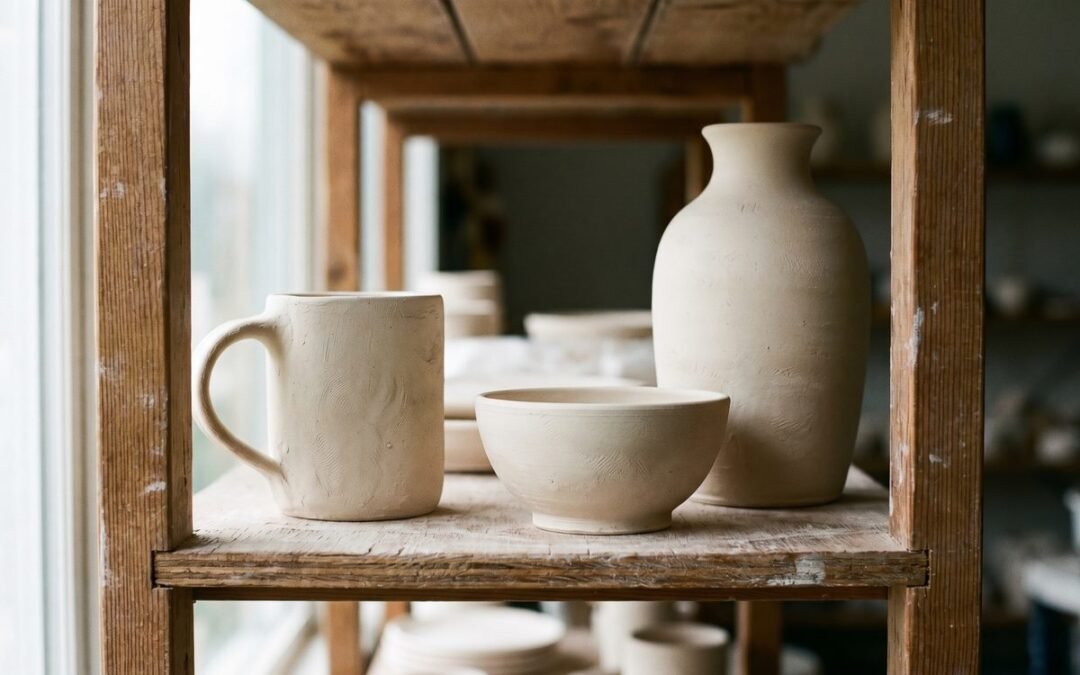
Can Pottery Be Too Dry to Fire? Bone Dry Clay and Kiln Readiness Explained
Bone-dry pottery is always safe to fire. The real danger is the opposite: under-dried clay. Moisture trapped inside the kiln turns to steam at 212°F and expands roughly 1,700 times its liquid volume, and that pressure is what causes cracks and explosions. Aim for bone dry every time, and handle the piece gently once it’s there.
If you’ve been worrying that you left a mug on the shelf for too long, breathe easy. The fear most beginners arrive with is backwards. Drying isn’t a window you can overshoot into danger. Drying is a destination, and the longer you take to reach it, the safer your kiln load becomes. The risk lives entirely on the other side of the line, in pieces that look ready but still hold water inside their walls.
This guide walks through what “bone dry” actually means, the two kinds of water hiding in every clay body, the practical tests potters have used for generations to confirm readiness, and the candling technique that professionals use as a safety net. By the end you’ll know exactly how to load a kiln with confidence.
The Short Answer: Can Pottery Be Too Dry?
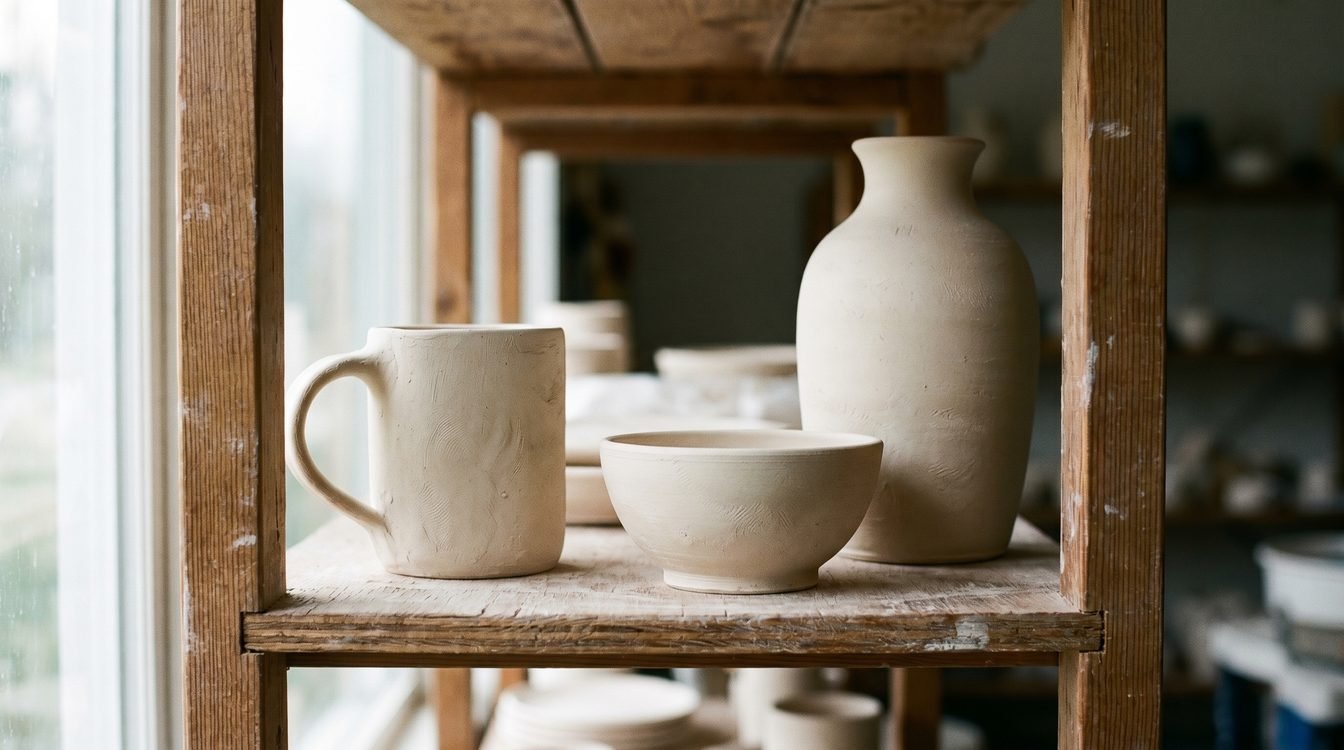
No. Not in any way that matters to your firing. A pot that has sat on the shelf for a month longer than it needed to is no harder to fire than one that hit bone dry yesterday. If anything, it’s a little safer, because there is less chance any pocket of unevaporated moisture is hiding inside a thick wall.
What “Bone Dry” Actually Means
Bone dry is the stage at which all free moisture has evaporated from the clay. The piece feels room temperature to the touch, has lightened noticeably in color, and has lost a measurable amount of weight. It is also brittle. The flexibility of leather-hard clay is long gone, replaced by something closer to a soft chalk. You can still scratch and burnish bone-dry clay, but a careless bump will snap a handle clean off.
Critically, bone dry does not mean the clay contains no water at all. It means it contains no water that air drying can remove. The rest is locked into the molecular structure of the clay itself, and only the kiln can release it.
Why Over-Drying Is Safer Than Under-Drying
Think of drying as a one-way door. Once free water leaves the clay, it cannot come back unless you actively reintroduce it. Leaving a piece on the shelf for an extra week, or even an extra month, doesn’t make it any wetter. It just makes it more reliably dry throughout, especially in thick bases and the inner walls of enclosed forms where moisture loves to linger.
The only thing you sacrifice by waiting is mechanical strength. A bone-dry piece will not survive being dropped, knocked off a shelf, or jammed against another pot in a crowded kiln. So the rule is simple: dry as long as you need to, then handle like it’s made of meringue.
Two Types of Water in Clay (Most Beginners Don’t Know This)
Here is the piece of the puzzle that almost no beginner guide explains, and it’s the reason “bone dry” can still produce a cracked pot if the kiln is rushed.
Clay contains two completely different kinds of water, and each is removed by a different mechanism at a different temperature. Confusing the two is the single most common source of misinformation in beginner forums.
Physical Water: What Air Drying Removes
Physical water, sometimes called free water or mechanical water, is the moisture that sits in the pores between clay particles. It’s what makes wet clay plastic and workable. It evaporates at room temperature through the surface of the piece, which is exactly what air drying is designed to do.
This is the water the cheek test, the color test, and the weight test detect. It must be completely gone before the pot enters the kiln. If it isn’t, the kiln will hit 212°F long before your slow-ramp safety zones, the remaining water will flash to steam, and the steam will try to escape faster than the clay walls can vent it. The result is a cracked rim at best and a shattered pot scattered across the kiln shelf at worst.
Chemical Water: What the Kiln Removes During Dehydroxylation
Chemical water is different. It is bonded directly to the clay molecules as hydroxyl groups, which is why ceramicists sometimes call it “water of crystallization.” No amount of air drying will touch it. As Ceramind Tools explains in their pottery cracking troubleshooting guide, these bonds only release when the kiln climbs into the 350°C to 550°C range (roughly 660°F to 1022°F), in a process called dehydroxylation.
During dehydroxylation, the water leaves as vapor at a much higher temperature than physical water did. If the kiln ramps too quickly through this range, the released vapor can still build enough pressure to crack a piece, even one that was perfectly bone dry on the shelf. This is why an 80 to 100°F per hour ramp through dehydroxylation is standard, and it’s part of the firing process every potter eventually internalizes.
| Feature | Physical Water | Chemical Water |
|---|---|---|
| What it is | Free moisture in clay pores | Water bonded to clay molecules |
| Removed by | Air drying | Kiln heat during dehydroxylation |
| Danger if fired too fast | Steam cracks or explosions below 212°F | Pressure cracks between 350°C and 550°C |
| How to ensure safe removal | Bone dry before kiln entry | Slow firing ramp (80 to 100°F per hour) through the 350 to 550°C range |
One last temperature worth knowing about: at 573°C (1063°F) the silica in your clay briefly expands during quartz inversion. It’s another zone where a slow ramp matters, and it’s why your kiln controller’s program is usually staged rather than a straight climb to peak temperature.
How to Tell If Your Pottery Is Bone Dry
You don’t need a moisture meter. Potters have been confirming dryness with their senses for thousands of years, and the tests still work. Use at least two of them together for any piece that matters.
The Cheek Test
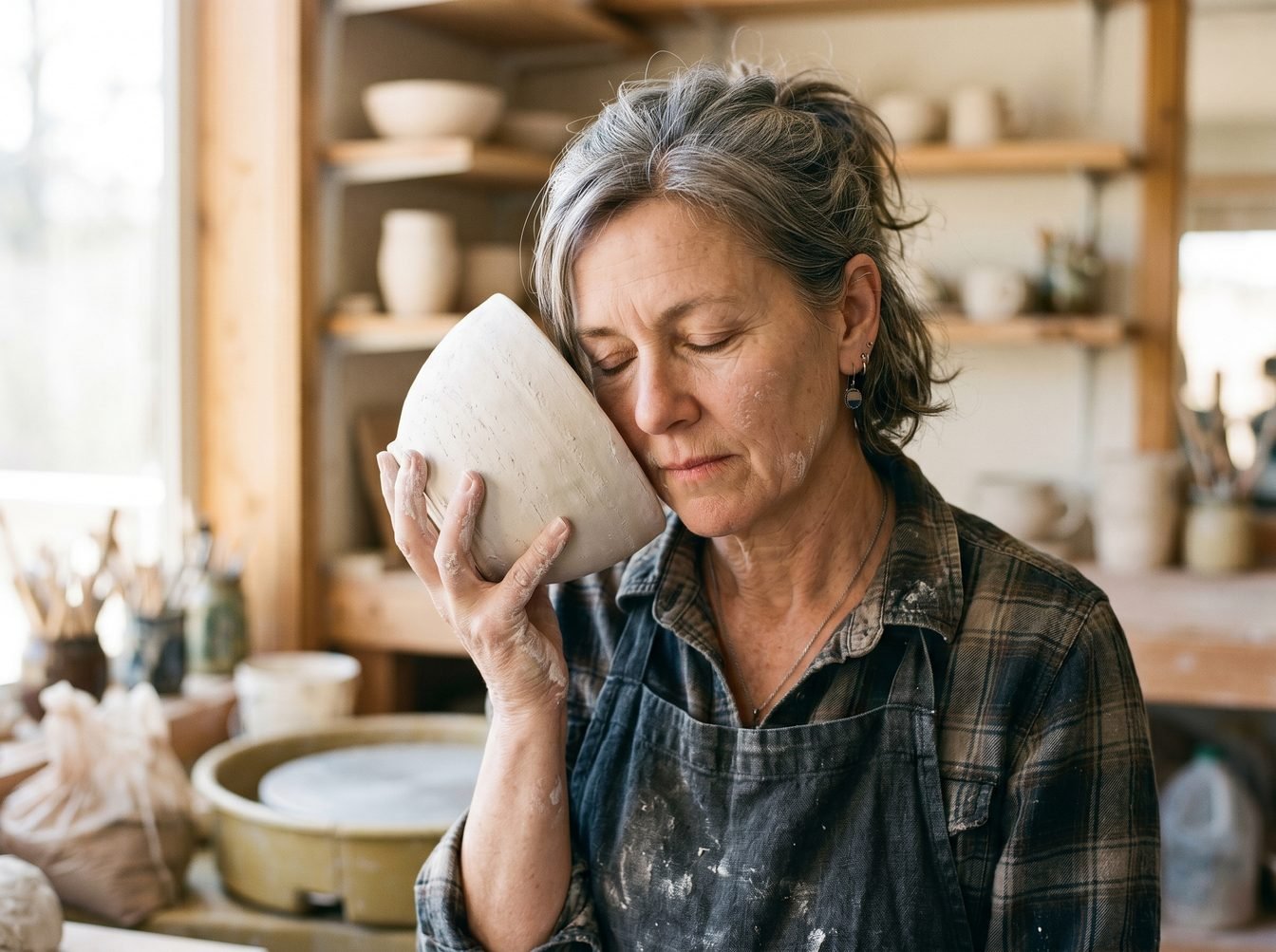
Press the pottery gently against the side of your cheek or the soft skin of your inner wrist. If the clay feels even slightly cool, water is still evaporating from the surface, and the evaporative cooling is what you’re sensing. If the piece feels exactly like the room around it, it’s almost certainly bone dry. The cheek is more sensitive than the back of your hand, which is why the Ceramic Arts Daily community has championed this test for decades. It costs nothing and takes two seconds.
The Color Test
As clay dries, it lightens. A wet stoneware that started slate grey will look almost dusty white by the time it’s bone dry. Look at the piece in good light and check for uniformity. If the rim and shoulders are pale but the base or the inside walls are visibly darker, that’s a moisture map telling you exactly where water is still hiding. Wait until the whole surface reads the same pale tone before you load.
The Weight Test
For potters who throw or build identical pieces, weight is a useful confirmation. A bone-dry mug weighs noticeably less than the same mug fresh off the wheel, often by 20 percent or more depending on clay body and form. If you weigh pieces after forming and again before loading, you’ll quickly develop an intuition for what “ready” feels like on the scale.
The Mirror Test
This one happens inside the kiln, during candling. Hold a small mirror, a piece of glass, or even a polished metal spoon to the kiln’s peephole for a few seconds. If it fogs with condensation when you pull it away, water vapor is still escaping the kiln, which means at least one piece inside still has physical water to release. Don’t advance the temperature. Keep holding at candling heat until the mirror comes out clear.
Drying Times by Piece Type
Drying isn’t a stopwatch sport. The numbers below are starting points based on a moderate studio environment with reasonable airflow, and they vary enormously with the form, the clay body, and the climate. Beleza Ceramics has a useful drying guide and checklist if you want a second reference point, but for most pieces the table below holds.
| Piece type | Minimum dry time |
|---|---|
| Small or thin (pinch pots, coasters, ornaments) | 7 to 10 days |
| Standard mugs, bowls, small plates | 10 to 14 days |
| Large or thick pieces | 14 to 21+ days |
| Enclosed or hollow forms | 21 to 28+ days |
| After underglaze application | Add 24 to 48 hours |
The climate caveat is doing a lot of work in that table. A piece that air-dries in seven days in a heated studio in Arizona may take three weeks in a coastal cottage in Cornwall, and an enclosed form with a narrow neck can take a month or more anywhere humid. Different clay bodies dry at different rates too, which is one reason it helps to understand the different types of pottery clay and how each behaves on the shelf. Porcelain holds water tightly. Coarse stoneware lets it go quickly. Earthenware sits somewhere in between. In cold or humid conditions, double the times in the table and rely on the cheek test rather than the calendar.
Candling: The Professional Way to Guarantee Safety
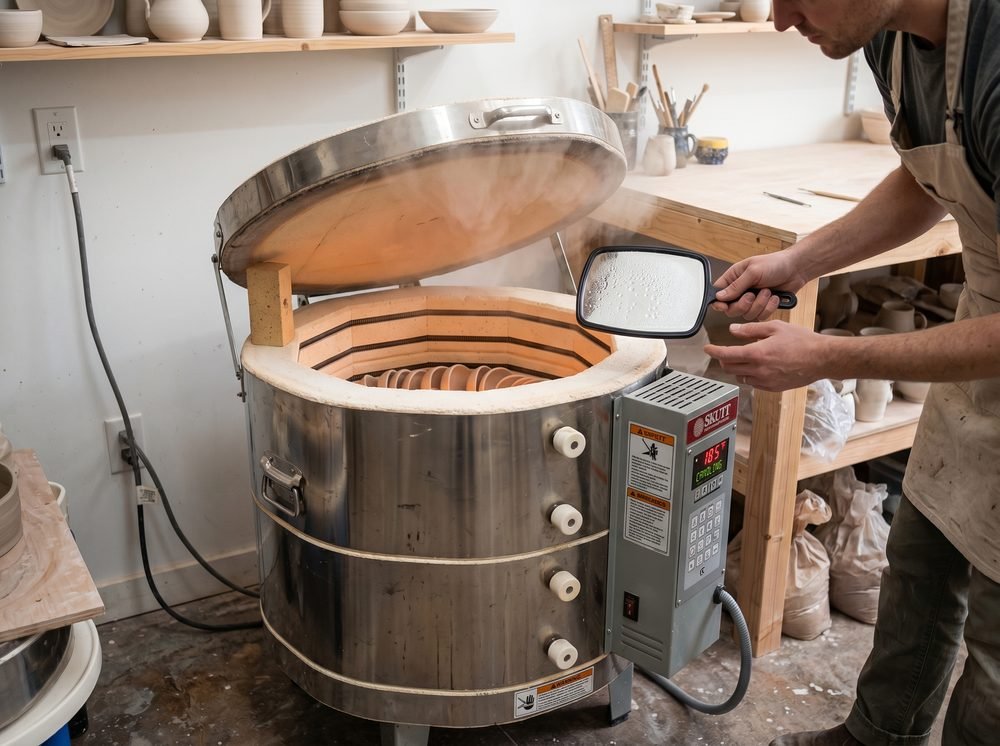
Candling is the safety net every cautious potter uses. It’s a slow, low-temperature pre-heating stage that sits comfortably below the boiling point of water and gives any last hidden moisture a graceful exit before the kiln climbs into dangerous territory. The Ceramic Arts Network’s guide to drying and firing treats it as standard practice for any piece you can’t be sure is bone dry, and we suggest treating it the same way.
The setup is simple. Bring the kiln up to between 180°F and 190°F (roughly 82°C to 88°C) and hold it there. Leave the lid propped open an inch or two if your kiln allows, and keep at least one peephole unplugged so vapor can escape. Because you’re below 212°F, water can leave as quiet steam rather than violent flash, and even a piece that’s slightly damp inside has time to release its moisture safely.
How long you hold candling depends on what’s inside the kiln. Two hours is usually enough for a load of small, thin pieces you’re confident in. Eight to twelve hours is sensible for large, thick, or enclosed forms, and overnight candling is common for a load you’re genuinely uncertain about. The mirror test is your signal to advance. When the glass at the peephole stops fogging, you’ve burned off the last of the physical water, and you can start the climb toward bisque temperature. From there, the same slow-ramp logic applies through the dehydroxylation and quartz inversion zones, which is why a full kiln firing typically takes many hours rather than a quick blast.
What Can Over-Drying Actually Do to Your Pottery?
Here’s the reassurance part. Nothing about over-drying will make your firing fail. The kiln doesn’t care whether your pot has been bone dry for a day or a year. The thermal and chemical events that turn raw clay into ceramic happen the same way either way.
What over-drying does do is make the piece more brittle on the shelf and during loading. Bone-dry clay has no plasticity left. It can crack from a finger pressed too firmly on a thin rim, from being set down hard on a stoneware shelf, or from the small shock of a kiln post brushing against a handle as you load. So the practical risk isn’t the firing, it’s the trip from the shelf to the kiln.
Handle bone-dry pieces with two hands underneath, never by handles or rims. Load with foam padding or a soft cloth on your worktop. If you’re transporting pieces between rooms, carry them on a tray with a non-slip liner. None of this is dramatic. It’s the same care you’d give any fragile object. If a piece does chip or crack on the way in, you can sometimes mend small defects with a slurry of the same clay body, let it re-dry, and proceed. For larger damage, it’s often easier to crush the piece and reclaim the clay.
And remember: bisque firing exists in part to make pots durable enough to handle for glazing. Many studios fire each piece twice, sometimes more, and repeat firings across multiple stages are part of how a finished piece earns its surface. The fragile bone-dry stage is brief. Get the piece into the kiln safely, and you’re past the worst of it.
FAQs
Can bone-dry pottery explode in the kiln?
It’s rare but possible, and the cause isn’t physical moisture. Bone-dry pottery still contains chemical water that releases during dehydroxylation between 350°C and 550°C. If the kiln ramps too quickly through this range, that chemical water can convert to steam fast enough to crack the piece. Fire slowly through this window, typically 80 to 100°F per hour, and the risk drops to almost nothing.
How do I know if my pottery is bone dry?
The cheek test is fastest. Press the piece against your inner wrist or cheek. If it feels even slightly cool, moisture is still evaporating. If it feels exactly like room temperature, it’s likely bone dry. Confirm with the color test (uniform pale color, no darker patches) and, if you weighed the piece after forming, the weight test.
What happens if you fire pottery that isn’t fully dry?
Moisture turns to steam at 212°F (100°C), and steam expands roughly 1,700 times its liquid volume. If that pressure can’t escape through the clay walls fast enough, the piece cracks or explodes inside the kiln. The shrapnel from a single exploding pot can damage every neighboring piece on the shelf, which is why slow drying and candling are worth the time.
Can you dry pottery too fast?
Yes, and this is where over-drying does become a problem, although before the kiln rather than inside it. Rapid drying from drafts, direct sun, or forced heat causes the outer layer of clay to shrink faster than the inner core. The resulting stress produces cracks before the piece ever reaches the kiln. Slow, even drying under loose plastic or cloth is always better.
How long does pottery need to dry before firing?
It depends on size, thickness, and climate. Small thin pieces such as pinch pots and coasters usually need 7 to 10 days. Standard mugs and bowls need 10 to 14 days. Large or thick pieces need 14 to 21 days or more. Enclosed forms can need a month. In humid environments, double these times and always run the cheek test before loading the kiln.
What is candling in pottery?
Candling is a kiln pre-heating stage held at 180 to 190°F (82 to 88°C) for several hours before the main firing begins. Because this temperature sits below the 212°F boiling point of water, any remaining physical moisture evaporates gradually rather than flashing into destructive steam. Hold the candling stage until a mirror placed at the peephole no longer fogs.